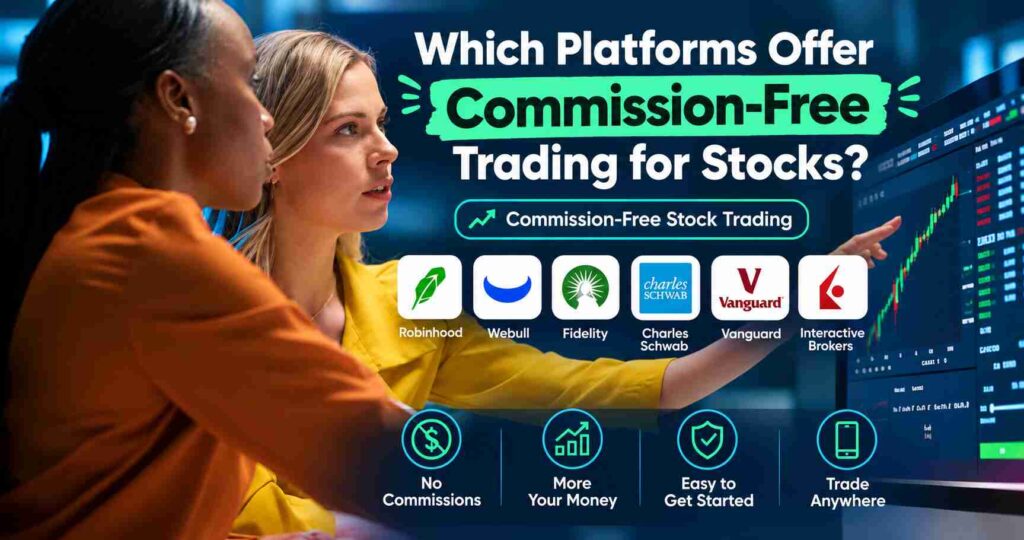
Eight major U.S. brokers currently charge $0 commission on standard online orders to buy or sell U.S.-listed stocks and ETFs: Robinhood, Fidelity, Charles Schwab, Vanguard, E*TRADE, J.P. Morgan Self-Directed Investing, Interactive Brokers (through its IBKR Lite plan), and Webull. Each broker’s pricing was checked against its own fee schedule as of September 2026.
A $0 commission is not the same thing as a $0 total cost of trading. Regulatory transaction fees, options contract fees, margin interest, wire transfers, and a handful of other charges can still apply depending on what you trade and how you place the order. The sections below cover what each platform actually offers, where real costs still show up, how commission-free brokers make money, and what to check before you open an account, including for readers outside the United States.
Broker pricing changes without much notice, so treat every figure here as a snapshot and confirm current terms on the broker’s own website before funding an account.
What is commission-free stock trading?
Commission-free stock trading means a broker charges no per-trade commission on standard online orders to buy or sell stocks and ETFs listed on a U.S. exchange. Before October 2019, most discount brokers charged $5 to $10 per trade. Charles Schwab cut its online stock and ETF commissions to $0 that month, and Fidelity, TD Ameritrade, and E*TRADE matched within days. The rest of the industry followed over the next year or two.
The $0 commission almost always applies to a specific, defined slice of trading activity: online self-directed orders, not broker-assisted ones; U.S.-listed stocks and ETFs, not foreign shares bought directly on a foreign exchange; and standard order sizes, not large block trades. Options contracts, mutual funds, bonds, and broker-assisted orders are priced separately at every firm covered in this article.
Which platforms offer commission-free stock trading?
Robinhood
Robinhood charges $0 for online trades of U.S.-listed stocks, ETFs, and options, with no account minimum. Options carry a standard fee of $0.65 per contract, which drops to $0 for subscribers to Robinhood Gold, a paid tier priced around $5 a month. Fractional shares are available starting at $1. Crypto trades are not commission-based; Robinhood builds in a spread instead, so the “$0 commission” label there works differently than it does for stocks. Robinhood generates revenue in part through payment for order flow, covered in more detail below.
Fidelity
Fidelity charges $0 for online U.S. equity and ETF trades, with a $0.65 per-contract options fee and no account minimum. Fractional shares are available for S&P 500 companies starting at $1 through its Stocks by the Slice program. One notable difference from most competitors: Fidelity states it does not accept payment for order flow on equity orders, though it does on options orders. A limited list of ETFs carries a separate $100 transaction-based service fee, and accounts flagged as Professional Equity Trader pay $0.001 per share instead of $0.
Charles Schwab
Schwab offers $0 online commissions on listed U.S. stocks and ETFs, plus a $0.65 per-contract options fee. Fractional shares, sold under the Stock Slices name, start at $1 for most U.S.-listed stocks and ETFs. There’s no account minimum. Broker-assisted trades cost $25, and automated phone orders cost $5. Schwab participates in payment for order flow on equity orders.
Vanguard
Vanguard charges $0 for online trades of ETFs and most U.S.-listed stocks. Options pricing is higher than most peers at $1.00 per contract. Vanguard does not support fractional-share purchases of individual stocks online, a real limitation compared with Fidelity, Schwab, and several others on this list. Standard brokerage and IRA accounts carry a $20 annual fee unless you enroll in electronic document delivery, at which point the fee is waived (it’s also waived automatically above $1 million in Vanguard assets). Vanguard is commonly cited, alongside Fidelity, among brokers that do not currently accept payment for order flow on equity trades, though broker routing practices can change and are worth confirming directly.
E*TRADE
ETRADE, now part of Morgan Stanley, charges $0 for online U.S.-listed stock and ETF trades. Options cost $0.65 per contract, dropping to $0.50 for accounts placing 30 or more stock, ETF, or options trades in a quarter. There’s no account minimum. Fractional-share support is narrower than at some competitors: ETRADE offers ETF fractional shares through its automatic investing feature with a $25 minimum, but doesn’t offer the same broad fractional-share buying for individual stocks that Fidelity, Schwab, and J.P. Morgan provide. A $25 broker-assisted fee applies, and moving a full account out to another firm (an ACAT transfer) carries a comparatively high $75 fee.
J.P. Morgan Self-Directed Investing
Available through Chase, J.P. Morgan Self-Directed Investing charges $0 online commissions on U.S. stocks, ETFs, and options, with a standard $0.65 per-contract options fee and no account minimum. Fractional shares are available for S&P 500 and Nasdaq-100 stocks and ETFs starting at $5. The platform integrates directly into the Chase Mobile app, which is convenient for existing Chase customers, but the product set is narrower than at full-service competitors: there’s no futures trading, and options strategies are limited to basic types like covered calls and cash-secured puts rather than multi-leg spreads.
Interactive Brokers (IBKR Lite and IBKR Pro)
Interactive Brokers runs two separate pricing plans. IBKR Lite offers $0 commissions on U.S.-listed stock and ETF trades, no account minimum, and no inactivity fee, with fractional-share access across a broad list of tens of thousands of securities. IBKR Pro is not commission-free; it uses a tiered, volume-based per-share pricing structure that starts around $0.005 per share with a roughly $1 minimum per order, dropping further at higher volumes. The trade-off: IBKR Lite participates in payment for order flow like most other zero-commission platforms, while IBKR Pro routes orders directly and does not. Interactive Brokers also accepts account applications from a wide range of countries outside the U.S., which sets it apart from several other brokers on this list for international readers.
Webull
Webull charges $0 for U.S. stock and ETF trades and, unusually among this group, $0 commission on equity and ETF options as well, with only small regulatory pass-through fees applying per contract. Index options carry a separate $0.50 per-contract fee, and option orders above 500 contracts add a $0.10 per-contract charge. There’s no account minimum, and fractional shares are available.
Commission-free trading comparison
| Platform | Stock/ETF commission | Fractional shares | Options pricing | Account minimum | Notable feature | Important caveat |
|---|---|---|---|---|---|---|
| Robinhood | $0 online, U.S.-listed | Yes, from $1 | $0.65/contract; $0 with Robinhood Gold | $0 | All-in-one app for stocks, options, and crypto | Crypto priced via spread, not commission; participates in PFOF |
| Fidelity | $0 online | Yes, S&P 500 names from $1 | $0.65/contract | $0 | Does not accept PFOF on equity orders | Select ETFs carry a $100 service fee |
| Charles Schwab | $0 online, listed | Yes, from $1 | $0.65/contract | $0 | 24/7 phone support and the thinkorswim platform | Broker-assisted trades cost $25; participates in PFOF |
| Vanguard | $0 online (ETFs and most stocks) | No individual-stock fractional shares | $1.00/contract | $0 (separate mutual fund minimums apply) | Investor-owned fund structure | $20 annual fee unless enrolled in e-delivery |
| E*TRADE | $0 online, listed | ETF only, via automatic investing (min. $25) | $0.65/contract, $0.50 after 30 trades/quarter | $0 | Power E*TRADE platform for active traders | $75 fee to transfer a full account to another broker |
| J.P. Morgan Self-Directed Investing | $0 online | Yes, S&P 500/Nasdaq-100 names from $5 | $0.65/contract | $0 | Built into the Chase Mobile app | No futures trading; options limited to basic strategies |
| Interactive Brokers (IBKR Lite) | $0, U.S.-listed | Yes, broad selection | Roughly $0.15-$0.65/contract depending on volume | $0 | Wide country eligibility for non-U.S. residents | IBKR Lite participates in PFOF; IBKR Pro is not commission-free |
| Webull | $0 | Yes | $0 commission plus small regulatory pass-through fees | $0 | Advanced charting and extended-hours trading | Index options carry a separate $0.50/contract fee |
Is commission-free trading really free?
No. A $0 commission removes one specific cost, the per-trade fee a broker used to charge for executing your order. Several other costs can still apply.
Regulatory transaction fees are set by the SEC and FINRA, not by your broker, and every U.S. broker passes them through. As of April 2026, the SEC’s Section 31 fee is $20.60 per $1 million of principal on sell orders. FINRA’s Trading Activity Fee, effective January 1, 2026, is $0.000195 per share on equity sales and $0.00329 per contract on options sales, capped at $9.79 per trade. On a typical retail-sized trade these amounts come to a few cents, but they are real and mandatory.
Bid-ask spreads are the gap between the price a buyer will pay and the price a seller will accept. Every trade crosses this gap, commission or not, and it’s often a bigger real-world cost than any fee on a broker’s rate sheet, particularly for less liquid stocks and ETFs.
Options fees run $0.65 per contract at most of these brokers, $1.00 at Vanguard, and $0 at Webull and at Robinhood Gold. Margin interest applies if you borrow against your portfolio, and rates vary meaningfully by broker and by how much you borrow. Account and service fees include things like Vanguard’s $20 annual fee for accounts not enrolled in e-delivery, wire transfer charges (commonly $25), and ACAT transfer-out fees that range from around $0 to $75 depending on the broker. Mutual fund transaction fees, ADR custody fees on foreign stocks held through American Depositary Receipts, and broker-assisted order surcharges round out the list. None of these make “commission-free” trading meaningless. For a buy-and-hold investor placing a handful of online stock or ETF trades a year, the realistic total cost is close to $0. For an active trader running options strategies or borrowing on margin, the gap between commission-free and cost-free can be substantial.
How do commission-free brokers make money?
Brokers that don’t charge trading commissions still need revenue, and they get it from several sources, not all of which apply to every firm.
Payment for order flow is one source, covered in detail in the next section. Interest on customer cash is another: brokers earn a spread between what they pay account holders on uninvested cash and what they earn holding or lending that cash themselves. Margin interest, the rate charged when a customer borrows against their portfolio, is a meaningful revenue line at brokers with large active-trader bases. Securities lending lets a broker lend out shares held in customer accounts (typically margin accounts) to short sellers and other borrowers, earning a fee in the process. Options-related revenue includes both per-contract fees where they’re charged and payment for order flow on options routing, which several brokers, including Fidelity, accept even when they decline it on equity orders. Subscription products, such as Robinhood Gold, add a direct fee-for-features revenue stream. And at Fidelity, Schwab, and Vanguard, asset management fees on proprietary mutual funds and ETFs, along with managed account and advisory fees, are a significant part of the broader business, separate from anything tied to a specific stock trade.
Not every broker relies on the same mix, and no single broker uses every source on this list. Fidelity, for instance, is largely funded by asset management on an $11-trillion-plus asset base rather than by trading revenue, which is part of why it can afford to skip payment for order flow on stock orders.
What is payment for order flow?
Payment for order flow, usually shortened to PFOF, is a payment that a wholesale market maker sends to a broker in exchange for the right to execute that broker’s customer orders. When you place a market order for a stock through a PFOF broker, the order often goes to a market maker like Citadel Securities or Virtu Financial rather than directly to a public exchange. The market maker fills the order and pays the broker a small amount, typically a fraction of a cent per share, for the opportunity.
Market makers pay for this order flow because retail orders are generally easier and more profitable to fill than institutional orders. A market maker can often capture part of the bid-ask spread on a retail trade while still filling it at or better than the best publicly quoted price, a legal and disclosed practice under SEC rules.
This creates a real, disclosed conflict of interest: a broker earning PFOF has a financial incentive to route to the market maker offering the largest payment, which is not necessarily the venue offering the best execution for the customer. U.S. broker-dealers are bound by a best execution obligation, codified in FINRA Rule 5310, that requires them to seek the most favorable terms reasonably available for customer orders regardless of where the broker’s own revenue comes from. Brokers must also publish quarterly order-routing disclosures under SEC Rule 606, showing which venues receive their orders and what payments they receive in return.
Does payment for order flow affect investors?
The evidence is mixed rather than one-sided, and the SEC and outside researchers have reached different conclusions depending on what they measured.
Multiple studies cited in Congressional Research Service analysis have found that PFOF-funded zero-commission trading reduced overall trading costs for retail investors compared with the pre-2019 commission model, even after accounting for any execution-quality difference. A 2022 study examining roughly 85,000 simultaneous market orders across five brokers found no meaningful harm to price execution from PFOF specifically. At the same time, the SEC’s own analysis, part of a 2022 rulemaking proposal that was not adopted, estimated that replacing the current PFOF-based system with a competitive order-by-order auction model could generate on the order of $1.5 billion in annual savings for retail investors, an estimate that multiple industry commentators disputed as too high.
None of this means PFOF automatically produces bad execution, and it doesn’t mean every broker that accepts PFOF is cutting corners on quality. It does mean the incentive exists, that regulators continue to scrutinize it, and that investors who want to avoid it entirely have real, if narrower, options: Fidelity and Vanguard on equity orders, and IBKR Pro rather than IBKR Lite at Interactive Brokers.
What should you compare besides trading commissions?
A $0 stock and ETF commission is now the baseline across the industry, which means it’s rarely the feature that should decide where you open an account. A few other factors matter more once commissions are equal across your shortlist.
Total cost across the products you’ll actually use matters more than the headline commission. An investor who trades options regularly should weigh the per-contract fee heavily; someone who never touches options shouldn’t let that number drive the decision. Spreads affect every trade regardless of commission, and they’re harder to compare directly since they move with market conditions rather than appearing on a fee schedule. Investment selection varies: not every broker offers the same range of mutual funds, bonds, international stocks, or fractional-share coverage. Fractional shares themselves differ meaningfully, from Vanguard’s lack of individual-stock fractional purchases to Fidelity, Schwab, and J.P. Morgan’s broader support.
Research and tools vary by platform, from basic charting to full analyst research and screening. App and platform quality is a personal-fit question; some investors want a simple mobile-first interface, others want a professional desktop platform like Schwab’s thinkorswim or Interactive Brokers’ Trader Workstation. Customer service availability, including 24/7 phone support, differs by firm. Margin rates matter for anyone who borrows, and they vary more than most other fees on this list. Cash yield, the interest rate paid on uninvested cash sitting in your account, can add up over a year and differs by broker and even by account type. If dividend income is part of your strategy, comparing expected yield across candidates with a dedicated tool, such as this dividend yield calculator, is more useful than looking at commission rates alone.
Transfer fees apply if you move your account to a different broker later, and they range widely, from $0 at some firms to $75 at E*TRADE. Regulatory protections are broadly similar across SIPC-member brokers, covered below, but confirming SIPC membership for any broker you’re considering is a reasonable baseline check. And for readers outside the United States, country eligibility is not optional background information; it can determine whether you can open an account at all, which the next two sections cover directly.
One more comparison point worth a mention: how you read your own account’s performance once you’re invested. Statements and apps report returns in different windows, and understanding the difference between year-to-date, trailing-twelve-month, and annualized figures, covered in more detail in this explainer on YTD, TTM, and annualized returns, will matter more to your results over time than the commission line on any single trade.
Can you trade stocks for free?
Yes, for the specific case of online orders on U.S.-listed stocks and ETFs at any of the eight brokers covered here, you can place that trade for $0 in commission. That is not the same as saying every dollar of investing activity is free. Regulatory fees still apply on sells, options and margin carry their own separate charges, spreads exist on every trade, and account or service fees can apply depending on what you do with the account. For a typical buy-and-hold investor trading occasionally in stocks and ETFs, the practical cost of trading is close to $0. For an active trader using options, margin, or frequent transfers, it is not, and the specific fee schedule of the broker you choose starts to matter a great deal.
Are commission-free trading platforms available in Pakistan?
Availability depends entirely on the individual broker, not on the general fact that U.S. brokers advertise $0 commissions. U.S. pricing does not automatically extend to international account holders, and several of the brokers covered in this article restrict new account applications to U.S. residents.
Robinhood, for example, requires a residential address in the U.S. or the U.K., a Social Security number rather than an ITIN, and status as a U.S. citizen, permanent resident, or valid visa holder, according to its own account eligibility terms. Vanguard has generally required U.S. citizenship or lawful permanent residence with a U.S. mailing address for new retail accounts. Interactive Brokers is a notable exception among the brokers covered here: it publishes a country eligibility list that includes a wide range of countries outside the U.S., and third-party broker reviews report that Pakistani residents can open an account, though the exact application requirements and available account types depend on IBKR’s specific entity for your country of residence. Fidelity, Schwab, and E*TRADE apply their own country-by-country rules that are stricter for new retail accounts than IBKR’s but can differ by account type and existing relationship, so the only reliable step is checking a specific broker’s own international or non-U.S. resident account page before assuming eligibility either way.
International investors who do open a U.S. brokerage account should also budget for costs that don’t show up in a U.S. resident’s fee schedule: currency conversion between the Pakistani rupee and U.S. dollar, international wire transfer fees for funding and withdrawing, and U.S. tax withholding on dividends paid to non-resident aliens, which typically requires filing a W-8BEN form with the broker. This article does not provide personalized tax advice; anyone in this position should confirm current requirements with the broker and, for tax treatment, a qualified tax professional familiar with both U.S. and Pakistani rules.
It’s also worth being precise about what “commission-free” refers to in this context. U.S. brokerage pricing, including everything described in this article, applies to trading U.S.-listed securities through a U.S.-regulated broker-dealer. It has no connection to brokerage pricing on the Pakistan Stock Exchange. PSX brokerage commissions are set separately under Securities and Exchange Commission of Pakistan and PSX rules, which prescribe a minimum commission of 3 paisa per share or 0.15% of transaction value, whichever is higher, with a maximum of up to 2.5% of transaction value, layered on top of capital gains tax and separate CDC and NCCPL charges. A $0 commission at a U.S. broker says nothing about what a PSX-licensed brokerage firm charges for trading Pakistani-listed shares, and the two markets should not be compared as if one pricing model applies to both.
Common misconceptions about commission-free trading
Commission-free means completely free. It means the per-trade commission is $0. Regulatory fees, spreads, options costs, margin interest, and account or service fees can still apply, as covered above.
All trades have zero fees at a commission-free broker. The $0 typically covers online orders in U.S.-listed stocks and ETFs specifically. Options, mutual funds, bonds, broker-assisted orders, and foreign securities are usually priced separately, even at brokers that advertise commission-free stock trading prominently.
Every broker has the same pricing. Options fees alone range from $0 at Webull to $1.00 per contract at Vanguard. Fractional-share support, account fees, and transfer costs also vary meaningfully across the eight platforms in this article.
Brokers cannot make money from free trades. They can, and do, through payment for order flow, interest on customer cash, margin lending, securities lending, subscriptions, and asset management fees, in varying combinations depending on the firm.
Payment for order flow automatically means bad execution. The regulatory and research record is mixed rather than conclusive. PFOF creates a disclosed conflict of interest that best-execution rules are designed to police, but it doesn’t automatically translate into worse fills for retail investors, and some research has found no measurable harm.
Every commission-free U.S. platform is available internationally. It isn’t. Country eligibility varies broker by broker, and several of the largest U.S. discount brokers restrict new accounts to U.S. residents.
Frequently asked questions
What is commission-free stock trading?
It’s a pricing model where a broker charges no per-trade commission on standard online orders to buy or sell stocks and ETFs listed on a U.S. exchange. It became the industry standard after Charles Schwab moved to $0 commissions in October 2019.
Which platforms offer commission-free stock trading?
Robinhood, Fidelity, Charles Schwab, Vanguard, E*TRADE, J.P. Morgan Self-Directed Investing, Interactive Brokers (through IBKR Lite), and Webull all currently offer $0 commissions on online U.S.-listed stock and ETF trades.
Can you trade stocks without paying a commission?
Yes, at any of the eight brokers above, for standard online orders on U.S.-listed stocks and ETFs. Other order types, products, and services at these same brokers can carry separate fees.
Is commission-free trading really free?
No. Regulatory transaction fees, bid-ask spreads, options contract fees, margin interest, and various account or service fees can still apply depending on how you use the account.
How do commission-free brokers make money?
Through some combination of payment for order flow, interest earned on customer cash, margin lending interest, securities lending, options-related fees and routing payments, subscription products, and asset management or advisory fees, depending on the firm.
Does Robinhood charge commissions on stocks?
No, standard online orders on U.S.-listed stocks are $0 commission. Regulatory pass-through fees, such as the SEC and FINRA fees described earlier, still apply on sell orders.
Does Fidelity offer commission-free stock trading?
Yes. Fidelity charges $0 for online U.S. equity and ETF trades and states it does not accept payment for order flow on equity orders, a policy that distinguishes it from most brokers on this list.
Does Charles Schwab offer commission-free stock trading?
Yes. Schwab has offered $0 online commissions on listed U.S. stocks and ETFs since October 2019, when it led the industry-wide move away from per-trade commissions.
What fees can still apply with a commission-free broker?
Regulatory transaction and Trading Activity Fees, options contract fees, margin interest, wire transfer fees, account transfer (ACAT) fees, broker-assisted trade surcharges, mutual fund transaction fees, and ADR custody fees are the most common.
Can Pakistani investors use commission-free U.S. brokers?
It depends on the specific broker. Some, like Interactive Brokers, accept applications from a wide range of countries including Pakistan. Others restrict new accounts to U.S. residents. Check the broker’s own international or non-U.S. resident eligibility page, and budget for currency conversion, wire transfer, and U.S. tax withholding costs that don’t apply to U.S.-resident accounts.
Conclusion
A $0 commission is a genuine, verifiable feature at Robinhood, Fidelity, Charles Schwab, Vanguard, E*TRADE, J.P. Morgan Self-Directed Investing, Interactive Brokers, and Webull for standard online trades in U.S.-listed stocks and ETFs. It is also only one line item in the real cost of using a brokerage account. Options pricing, fractional-share support, margin rates, account fees, execution practices, available tools, and, for readers outside the U.S., basic account eligibility all vary enough between these platforms to matter more than the commission line once you’ve confirmed it’s $0 across your shortlist. The more useful comparison is not which platform advertises free trades the loudest, but which one’s complete pricing structure, investment selection, and features fit how you actually plan to invest.
Source notes
Pricing, regulatory, and PFOF information in this article was checked against the following primary and regulatory sources as of September 2026:
- Robinhood, “Trading fees on Robinhood,” robinhood.com
- Fidelity, “Straightforward and Transparent Pricing” and “Fractional Shares,” fidelity.com
- Charles Schwab, “Pricing” and “Fractional Shares,” schwab.com
- Vanguard, “Brokerage services commission & fee schedules” and “ETF fees and minimums,” investor.vanguard.com
- E*TRADE, “Rates and Fees,” us.etrade.com
- Chase / J.P. Morgan, “Fee and Commission Schedule for Self-Direct Investing,” jpmorgan.com, and “Fractional Shares Trading,” chase.com
- Interactive Brokers, “IBKR Fact Sheet,” “Try IBKR Lite,” and “Available Countries and Territories,” interactivebrokers.com
- Webull, “Options Trading on Webull’s Commission-Free Platform,” webull.com
- U.S. Securities and Exchange Commission, “Executing an Order” (Investor.gov) and Fee Rate Advisory on Section 31 fees, sec.gov
- FINRA, “Trading Activity Fee” and Section 1 of Schedule A to FINRA’s By-Laws, finra.org
- Securities Investor Protection Corporation, “What SIPC Protects,” sipc.org
- Congressional Research Service, “Payment for Order Flow (PFOF) and Broker-Dealer Regulation,” via congress.gov
- Pakistan Stock Exchange, “Account Opening Checklist” and brokerage commission notices, psx.com.pk


