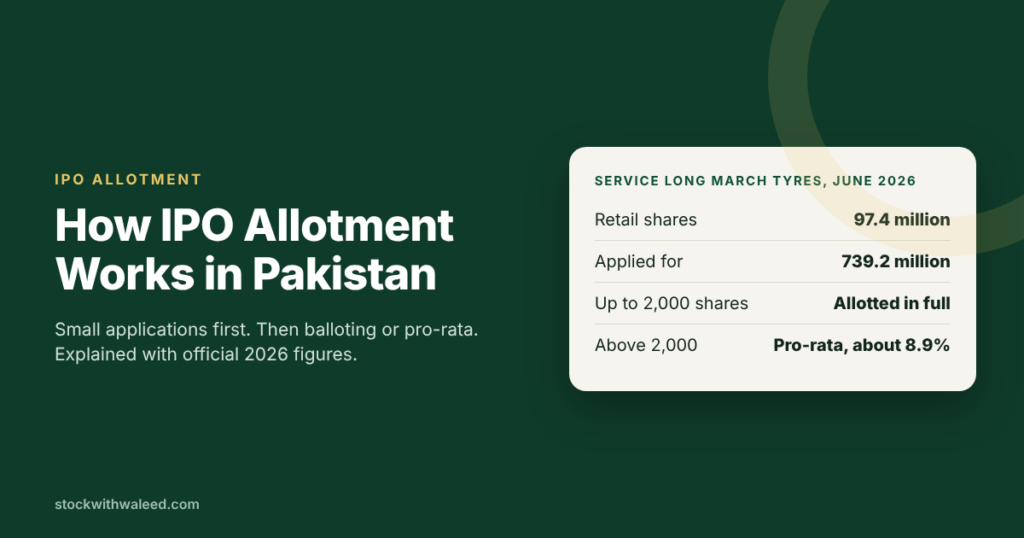
IPO allotment in Pakistan works like this: if the retail portion gets fewer applications than shares on offer, everyone gets what they applied for. If it is oversubscribed, the lead manager and share registrar announce a basis of allotment, and in 2026 that basis has almost always meant small applications are filled in full, the bracket at the cut-off is balloted or cut back, and large applications are allotted pro-rata or refunded. In five of the seven 2026 retail offers covered below, every application for 2,000 shares or fewer was filled in full. The two exceptions were the most heavily oversubscribed: Pak-Qatar General Takaful filled only applications up to 1,500 shares, and LSE SPAC-II only those for 500.
The cut-off isn’t announced in advance. It depends on how many people apply in each size bracket, so the same 10,000-share application got about 85% of its shares in one 2026 IPO and nothing at all in another. This guide uses the official subscription notices filed with PSX to show how the rule is set, how to work out your own allotment, and what happens when an IPO doesn’t complete.
IPO Allotment in Pakistan 2026 retail allotments at a glance
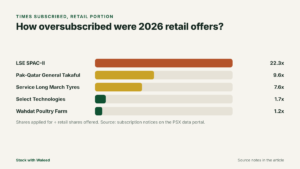
Every figure below comes from the subscription results letter filed with PSX or, where noted, from press coverage of it.
| IPO (retail dates) | Retail shares offered | Times subscribed | Basis of allotment | Outcome for large applications |
|---|---|---|---|---|
| Pak-Qatar General Takaful (Jan 28–29) | 7,500,000 | 9.56x | Up to 1,500 in full; 2,000 balloted; above 2,000 refunded | Nothing allotted |
| Ghani Dairies (Feb 9–10) | 26,050,000 | About 1.67x | Up to 2,000 in full; above pro-rata | Pro-rata (bracket data not published in the coverage) |
| Wahdat Poultry Farm (Apr 27–28) | 15,930,705 | 1.16x | Up to 2,000 in full; above pro-rata | About 85% of shares applied for |
| Sitara Petroleum (May 11–12) | 42,000,000 | 3.42x | Up to 2,000 in full; above pro-rata | About 18% |
| Service Long March Tyres (Jun 3–4) | 97,434,510 | 7.59x | Up to 2,000 in full; above pro-rata | About 9% (see the clawback note below) |
| Select Technologies (Jul 2–3) | 22,222,222 | 1.73x | Up to 2,000 in full; above pro-rata | About 36% |
| LSE SPAC-II (July) | 2,000,000 | 22.27x | 500 in full; 1,000 balloted; 1,500 and above not entertained | Nothing allotted |
Sources: subscription letters for Pak-Qatar, Wahdat, Sitara, Service Long March Tyres, Select and LSE SPAC-II; Ghani Dairies figures from Mettis Global, February 12, 2026. Percentages for large applications are estimates worked out from the bracket tables, as shown later in this guide.
Two separate allotments: book building and retail
Most Pakistani IPOs now split the offer into two parts:
- Book building portion (usually 75%): institutions and high-net-worth individuals bid through PSX’s book building system. The minimum bid is Rs 2 million since SECP’s July 2025 amendments, up from Rs 1 million (Business Recorder). The strike price comes from this auction.
- Retail or general public portion (usually 25%): anyone can apply at the strike price through PSX e-IPO or CDC’s e-IPO system.
This article is about the retail portion, which is where nearly all individual investors apply. Book building allotment follows its own rules: under the Public Offering Regulations, 2017, bids above the strike price are filled first, and bids exactly at the strike price share whatever is left on a proportionate basis. That process is explained in book building vs fixed price IPOs.
Step 1: Count the demand in each size bracket
After the subscription window closes, the share registrar (often CDC Share Registrar Services) compiles applications from both e-IPO systems. The lead manager then writes to PSX with a table that groups applications by size. In 2026, these tables have used five brackets: 500, 1,000, 1,500, 2,000 and “above 2,000” shares.
Here is the actual table for Service Long March Tyres Limited, whose retail subscription ran on June 3–4, 2026 (source: Arif Habib Limited letter to PSX, June 8, 2026):
| Application size | Applications | Shares applied for |
|---|---|---|
| 500 | 6,522 | 3,261,000 |
| 1,000 | 7,037 | 7,037,000 |
| 1,500 | 2,745 | 4,117,500 |
| 2,000 | 10,178 | 20,356,000 |
| Above 2,000 | 6,708 | 704,400,000 |
| Total | 33,190 | 739,171,500 |
The letter gives the issue size as 97,434,510 shares. Total demand was about 7.6 times that.
Step 2: Fill the small brackets first
The basis of allotment works upward from the smallest applications. For Service Long March Tyres, the announced rule was: applications for up to 2,000 shares allotted in full; above 2,000 shares allotted pro-rata.
Run the numbers and you can see why that cut-off worked:
- All applications up to 2,000 shares together asked for 34,771,500 shares.
- That left 97,434,510 − 34,771,500 = 62,663,010 shares for the “above 2,000” bracket.
- That bracket asked for 704,400,000 shares, so it could be covered about 8.9% (62,663,010 ÷ 704,400,000).
So a person who applied for 10,000 shares would have received roughly 890 shares, if the pro-rata factor was applied to the whole application, and a refund for the rest. Someone who applied for exactly 2,000 shares got all 2,000. The registrar applies the precise method and rounding, so treat these as estimates.
Step 3: If the small brackets alone exceed supply, balloting starts
When even the small applications can’t all be filled, the cut-off moves down, and the bracket right at the cut-off is decided by a ballot (a random draw).
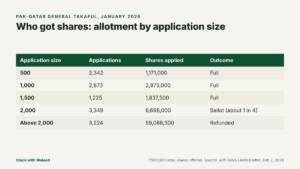
Pak-Qatar General Takaful’s retail offer in January 2026 shows this clearly. The retail portion was 7,500,000 shares and drew applications for 71,668,000, about 9.6 times (source):
| Application size | Applications | Shares | Outcome announced |
|---|---|---|---|
| 500 | 2,342 | 1,171,000 | Allotted in full |
| 1,000 | 2,873 | 2,873,000 | Allotted in full |
| 1,500 | 1,225 | 1,837,500 | Allotted in full |
| 2,000 | 3,349 | 6,698,000 | Balloting |
| Above 2,000 | 3,224 | 59,088,500 | Refunded |
The math: the three smallest brackets took 5,881,500 shares. That left 1,618,500 shares, enough for about 809 of the 3,349 applications for 2,000 shares, roughly a 1-in-4 chance. Everyone who applied for more than 2,000 shares got nothing and had their money refunded.
That last point surprises people. In a heavily oversubscribed IPO, a bigger application can leave you with fewer shares than a small one.
An even tighter case: LSE SPAC-II
LSE SPAC-II offered just 2,000,000 shares to the public in July 2026 and was oversubscribed 22.27 times, with 8,707 applications (source). The announced basis, citing the prospectus, was:
- 500-share applications: allotted in full (1,048,000 shares)
- 1,000-share applications: balloting
- 1,500 shares and above: not entertained
After the 500-share bracket, 952,000 shares remained for 2,023 applications of 1,000 shares, so about 952 could win, a little under a 1-in-2 chance.
A middle case: Sitara Petroleum
Sitara Petroleum Service Limited sits between the extremes. Its 42,000,000-share retail portion drew 23,757 applications for 143,505,000 shares, about 3.4 times, on May 11–12, 2026 (Arif Habib Limited letter, May 15, 2026):
| Application size | Applications | Shares |
|---|---|---|
| 500 | 6,582 | 3,291,000 |
| 1,000 | 5,872 | 5,872,000 |
| 1,500 | 1,880 | 2,820,000 |
| 2,000 | 3,623 | 7,246,000 |
| Above 2,000 | 5,800 | 124,276,000 |
| Total | 23,757 | 143,505,000 |
Applications up to 2,000 shares were allotted in full and took 19,229,000 shares. That left 22,771,000 shares for applications above 2,000, which had asked for 124,276,000. The pro-rata factor works out at about 18.3%, so a 10,000-share application at Rs 18.90 (Rs 189,000 paid) would have received roughly 1,830 shares and about Rs 154,400 back.
The amount column in the letter also confirms the price: Rs 2,712,244,500 for 143,505,000 shares is exactly Rs 18.90 a share, the strike price set in book building.
When oversubscription is mild
Not every IPO is a scramble. Two 2026 examples with detailed bracket tables:
| IPO | Retail shares offered | Applied for | Times subscribed | Announced basis |
|---|---|---|---|---|
| Wahdat Poultry Farm (April 2026) | 15,930,705 | 18,430,000 | 1.16x | Up to 2,000 in full; above pro-rata |
| Select Technologies (July 2026) | 22,222,222 | 38,433,500 | 1.73x | Up to 2,000 in full; above pro-rata |
For Select, after filling everything up to 2,000 shares (13,051,500 shares), 9,170,722 shares were left for applications above 2,000, which had asked for 25,382,000. That is a pro-rata factor of about 36%. A 10,000-share application would have received roughly 3,600 shares.
Ghani Dairies followed the same pattern in February. Its retail offer of about 26.05 million shares at Rs 33 drew 11,797 applications for 43.45 million shares, and applications up to 2,000 shares were filled in full with the rest pro-rata (Mettis Global).
Wahdat Poultry: what a near-balanced book looks like
When demand barely exceeds supply, the cut-off sits high and large applications get most of what they asked for. Wahdat Poultry Farm’s retail subscription on April 27–28, 2026 had these brackets:
| Application size | Applications | Shares |
|---|---|---|
| 500 | 963 | 481,500 |
| 1,000 | 781 | 781,000 |
| 1,500 | 177 | 265,500 |
| 2,000 | 371 | 742,000 |
| Above 2,000 | 439 | 16,160,000 |
| Total | 2,731 | 18,430,000 |
Against 15,930,705 shares offered, the brackets up to 2,000 used 2,270,000 shares, leaving 13,660,705 for applications above 2,000, which had asked for 16,160,000. The pro-rata factor works out at roughly 85%. Large applicants got most of what they asked for, a very different result from Service Long March Tyres.
Notice too how much of the demand came from larger applications: 439 applicants accounted for 88% of shares applied for. When large applicants dominate a book, small applicants are well protected; when thousands of people apply for 2,000 shares, the cut-off falls.
How much does a big application get? A table
Using the Service Long March Tyres figures (pro-rata factor about 8.9% for applications above 2,000 shares, strike price Rs 19.95), here is roughly what different application sizes would have received:
| Applied for | Paid | Shares received (approx.) | Refund (approx.) |
|---|---|---|---|
| 2,000 | Rs 39,900 | 2,000 (full) | Rs 0 |
| 2,500 | Rs 49,875 | 222 | Rs 45,446 |
| 5,000 | Rs 99,750 | 444 | Rs 90,892 |
| 10,000 | Rs 199,500 | 889 | Rs 181,764 |
| 20,000 | Rs 399,000 | 1,779 | Rs 363,509 |
| 50,000 | Rs 997,500 | 4,447 | Rs 908,782 |
Notice the jump at the cut-off: an application for 2,500 shares, just one lot above the guaranteed bracket, would have ended up with about a tenth of the shares an application for 2,000 received. The people who applied for 2,000 shares were the clear winners of that issue’s allotment. Nobody knew in advance that 2,000 would be the cut-off, which is why the bracket sizes matter less than applying for an amount you’d be happy to hold in full.
The same 10,000-share application across 2026 issues shows how much the result swings:
| IPO | Strike price | Paid for 10,000 shares | Shares received (approx.) |
|---|---|---|---|
| Wahdat Poultry Farm | Rs 18.00 | Rs 180,000 | About 8,450 |
| Select Technologies | Rs 34.00 | Rs 340,000 | About 3,610 |
| Sitara Petroleum | Rs 18.90 | Rs 189,000 | About 1,830 |
| Service Long March Tyres | Rs 19.95 | Rs 199,500 | About 890 |
| Pak-Qatar General Takaful | Rs 14.00 | Rs 140,000 | 0 (full refund) |
The clawback: when the retail portion grows
SECP’s July 2025 amendments added a clawback provision that allows the retail allocation to increase by up to 10% when retail investors oversubscribe (Business Recorder). Shares move out of the book building portion and into the retail pool, which raises everyone’s pro-rata factor.
Service Long March Tyres may be an example. Its subscription letter gives the issue size as 97,434,510 shares, which is 25% of the 389.7 million-share offer. But the lead manager’s IPO page says that after the general public portion was oversubscribed, 5% was moved from book building, for a final split of 70% book building and 30% general public (Arif Habib Limited). If that reallocation applied to the retail allotment, the pool would have been about 116.9 million shares and the pro-rata factor closer to 11.7% than 8.9%. Treat the table above as the lower end of the range for that issue.
The lesson for your own estimate: check whether the results letter or a later notice mentions a reallocation before you calculate.
How to read a subscription results notice
Notices are posted on the PSX data portal and attached to the company’s PRIDE page under “Subscription Results”. Each one usually contains:
- The subscription dates and whether the window started and ended at midnight
- Total shares applied for against the issue size
- A table of applications, shares and amounts by bracket
- The basis of allotment in one or two sentences, sometimes citing the prospectus section
- The letter from the registrar compiling PES and CES figures
The amount column also tells you the strike price: Pak-Qatar’s total of Rs 1,003,352,000 for 71,668,000 shares works out to Rs 14 a share.
What decides the cut-off?
The cut-off isn’t fixed in advance. It comes from three things:
- The size of the retail portion. A tiny retail offer like LSE SPAC-II’s 2 million shares fills up with small applications alone.
- How many people apply in each bracket. Thousands of 2,000-share applications push the cut-off down. Pak-Qatar had 3,349 of them against a pool that could fill only about 809.
- The prospectus rules. Each prospectus has a retail allotment section (Section 13 in Sitara’s and Select’s) that sets the framework the registrar follows. The LSE SPAC-II letter, for example, cites section 12.5 of its prospectus.
A rough rule from the 2026 data: when retail demand was under about 3.5 times, the cut-off stayed at 2,000 shares and large applications got a meaningful pro-rata share. At 7.6 times it still held at 2,000, but large applications got under a tenth. At 9.6 times and above, with smaller retail pools, the cut-off dropped and large applications got nothing. This is a pattern from seven issues, not a rule written anywhere.
What the regulations require
The rules that bind every issue sit in two places: the SECP’s Public Offering Regulations, 2017 and chapter 5 of the PSX Rule Book.
- Results within three working days. The company must report subscription results to PSX, with bankers’ certificates, within three working days of the close (PSX Rule Book clause 5.5.8(a)).
- Ballot register to PSX. If an issue is oversubscribed, the company must immediately send PSX copies of the ballot register of successful applications (clause 5.5.8(d)).
- Allotment, CDS credit and refunds. Regulation 11(4) of the Public Offering Regulations and clause 5.5.8(b) and (e) of the rule book set the deadline for allotting shares, crediting CDS accounts and refunding unsuccessful applicants. The published versions give ten working days from the close of subscription. In October 2026, Mettis Global reported the current rule book deadline as five working days (Mettis Global). The prospectus of each issue states the timeline that applies to it.
- Undersubscription. Unsubscribed retail shares are taken up by the underwriters or allotted to successful book building bidders at the strike price on a pro-rata basis (regulation 11(5)).
- A minimum spread. PSX won’t list a company unless its public issue is subscribed by at least 500 applications (clause 5.5.3).
What if the retail portion is undersubscribed?
Then every valid application is allotted in full, and the shares left over go to the underwriters or to successful book building bidders, as the prospectus specifies. Recent prospectuses state the retail portion is fully underwritten. Sitara Petroleum’s, for example, names Arif Habib Limited as underwriter for all 42,000,000 retail shares, and Select Technologies’ names four underwriters for its 22,222,222 retail shares.
What if the IPO doesn’t go ahead?
Allotment assumes the company lists. If it doesn’t, the money comes back under a different rule. Section 69 of the Companies Act, 2017, as summarised in recent prospectuses, makes an allotment void if PSX listing permission isn’t granted within 21 days of the subscription closing, a period PSX can extend up to 42 days. The company must then refund all application money, and if it doesn’t do so within eight days of becoming liable, its directors become jointly and severally liable to repay it with a surcharge of 2% for each month or part of a month.
SE Fruits and Vegetable Limited is a live example. Its book building on September 21–22, 2026 closed at the Rs 40 floor price, about 1.6 times covered, and its 7.5 million-share retail portion closed on September 29. No results or allotment had been published by October 12 (Mettis Global). On October 13, the company said it would withdraw its listing application and refile with additional disclosures, describing it as a procedural step; its statement did not mention refunds (Lahore Times, October 14, 2026). Counting 21 days from the September 29 close gives October 20, 2026 as the date by which listing permission would normally be needed, unless PSX extends it.
If you are in a situation like this, keep your application reference and payment receipt, watch the company’s PSX announcements, and use the escalation steps in IPO refunds in Pakistan if the money doesn’t arrive.
How to estimate your own allotment
You can’t know the result before the subscription figures come out, but once the lead manager’s letter is on the PSX data portal, you can work it out:
- Note the retail shares offered, and check for any clawback reallocation.
- Add up shares in the brackets the letter says are “allotted in full”.
- Subtract that from the shares offered.
- If your bracket is “pro-rata”, divide the remainder by your bracket’s total shares. Multiply by your application size.
- If your bracket is “balloting”, divide the remainder by the shares per application to get the number of winners, then divide by the number of applications in your bracket for your odds.
Worked through for Sitara, a 6,000-share application: 22,771,000 ÷ 124,276,000 ≈ 18.3%, and 6,000 × 18.3% ≈ 1,100 shares. At Rs 18.90, that is about Rs 20,800 of shares from Rs 113,400 paid, with roughly Rs 92,600 refunded.
Our IPO application calculator does both calculations.
Strategies that follow from the rules
These are observations from 2026 results, not guarantees:
- For a hot IPO, a modest application often beats a large one. In Pak-Qatar General Takaful, 1,500 shares guaranteed a full allotment while anything above 2,000 got nothing.
- Don’t split one person’s money across fake applications. Applications in other people’s names without their genuine participation can be treated as false or fictitious. Prospectuses warn that such money may be forfeited under Section 87(8) of the Securities Act, 2015. Genuine family members applying with their own CNICs and money are a different matter.
- Don’t over-borrow to apply big. Pro-rata cuts mean most of a large application often comes back as a refund, and you lose the money’s use for a week or two.
- Watch the book building result. Pak-Qatar’s book was covered 21 times and its retail portion 9.6 times; Service Long March Tyres’ book 16.7 times and retail 7.6 times. Select’s book was covered 3.2 times and retail 1.7 times. Book demand has been a fair guide to retail demand.
- Look at the size of the retail pool. A 2 million or 7.5 million-share retail portion can be filled by small applications alone. A 42 million or 97 million-share pool leaves room for large applicants.
How the rules got here
The current approach is the product of several rounds of SECP changes:
- 2017: the Public Offering Regulations replaced older rules and introduced the e-IPO framework alongside a revamped book building process.
- 2018: amendments changed book building allotment from a time-priority basis to a proportionate basis, to widen the investor base (ProPakistani). The same round deleted an earlier provision for moving shares to retail investors when they oversubscribed.
- 2020: SECP revised the procedure for allocating shares to retail investors and set out what the supplement to the prospectus must contain (Business Recorder).
- 2025: eligible participants replaced the single book runner, 100% book building was withdrawn, the retail clawback was brought back, and physical applications ended from September 1, 2025.
Each prospectus applies the version in force when it’s approved, so always read the allotment section of the issue you’re applying for.
When will you know?
Subscription figures with the allotment basis have typically reached PSX within two to four working days of the close in 2026: Pak-Qatar closed January 29 and its letter is dated February 2; Sitara closed May 12 and its letter is dated May 15; Select closed July 3 and its letter is dated July 7. Shares are then credited to CDS accounts and refunds paid within the deadline described above. Sitara’s shares listed on May 21, nine days after its subscription closed. Read IPO refunds in Pakistan for the refund side.
What “not entertained” and “refunded” really mean
Notices use slightly different words for the same outcome. “Not entertained” (LSE SPAC-II) and “amount … shall be refunded” (Pak-Qatar General Takaful) both mean applications in that bracket receive no shares and the full payment is returned. It’s not a penalty and doesn’t affect future applications. It simply means there weren’t enough shares to reach that bracket.
Participation is rising, which tightens allotments
The number of people applying has grown fast. PSX’s CEO said average retail participation per IPO rose from 2,186 investors in 2024 to 9,008 in 2026 up to early May (The News). Sitara Petroleum’s retail portion drew 23,757 applications and Service Long March Tyres’ 33,190. With retail portions of similar size, more applicants means lower cut-offs and more balloting, especially for issues with small retail portions.
Book building allotment, briefly
If you bid in book building rather than the retail portion, allotment works differently. Successful bidders are those who bid at or above the strike price. The supplement to the prospectus shows how shares were split among categories. In Select Technologies’ June 2026 book, 436 investors took part and 295 were successful, with high net worth individuals receiving 30,522,345 of the 66,666,667 book building shares (source). See book building explained.
Frequently asked questions
Do husband and wife get separate allotments?
Yes, if each applies genuinely in their own name, with their own CNIC, CDC account and money. Each application is treated separately in the brackets.
Does the platform I used (PES or CES) affect allotment?
No. The registrar combines applications from PSX’s and CDC’s e-IPO systems before applying the basis of allotment.
Does applying early improve my chances?
No. Retail allotment in these cases depends on application size and the ballot, not on time of application. Applying early only protects you from last-minute payment problems.
Is the ballot really random?
Balloting is carried out by the share registrar under the prospectus and regulations, and when an issue is oversubscribed the company must send PSX copies of the ballot register of successful applications. Results show up as credited shares in your CDC account or a refund to your bank.
Can I check whether I won the ballot?
Check your CDC account (through your broker or CDC’s investor services) for the credited shares, and your bank account for a refund. The registrar may also email results.
Is the cut-off always 2,000 shares?
No. It was 2,000 in five of the seven 2026 issues covered here, 1,500 in Pak-Qatar and 500 in LSE SPAC-II. It depends on demand in each issue.
Start here if you haven’t applied before: how to apply for an IPO in Pakistan.
Figures come from official subscription notices on the PSX data portal and the press coverage cited. Pro-rata and balloting estimates are illustrations using those figures; the registrar’s final method and rounding decide actual allotments. Not investment advice. Last updated: October 15, 2026.


