An indexed universal life policy is life insurance first and a savings account second, and that order explains most of the criticism. The product is usually sold as a retirement plan, so buyers judge it as one, and judged as one it normally loses to a plain index fund held inside a 401(k), a Roth IRA or a taxable brokerage account. Before a single dollar reaches the index account, your premium pays a premium load, an administrative charge and a cost of insurance that rises every year you age. Whatever survives gets credited through a formula with a ceiling on the upside, and that formula almost always tracks the index price alone, so dividends never reach you.
So the short version of why IUL is a bad investment for most people: you are paying insurance company pricing for equity exposure you could buy for a few basis points, and you are locking it behind a surrender period. That is a real cost, not a talking point.
It is also not the whole story. IUL is a legitimate, state regulated insurance contract, not a fraud, and there are narrow situations where permanent coverage genuinely earns its keep. Roughly 88% of universal life policies never pay a death claim, which tells you how often the plan and the buyer part ways. The job of this article is to show you the mechanics, the numbers and the questions to ask, so you can tell which situation you are in before you sign anything.
Quick answer: why is IUL considered a bad investment?
IUL gets called a bad investment because the insurance wrapper takes a large, permanent cut of money that is being used to chase market returns. The specific complaints are:
- Capped upside. A cap, a participation rate or a spread trims your credit in the years the index does well.
- No dividends. Crediting is normally based on index price change only.
- Cost of insurance rises with age and is deducted from the policy, not from the illustration.
- Front loaded charges mean early cash value is far below premiums paid.
- Surrender charges can run a decade or more.
- Illustrations are projections, not promises, and the guaranteed column looks nothing like the sales column.
- Policy loans accrue interest and can quietly consume the policy.
- Underfunded policies lapse, sometimes with a tax bill attached.
- Caps and charges can change within contractual limits after you buy.
- Simpler alternatives are cheaper, more transparent and more liquid.
Now the part the critics skip: an IUL is primarily life insurance with a cash value component attached. Whether it is a bad purchase depends on your insurance need, your age and health, your premium budget, how the policy is designed and funded, your time horizon, whether you have already filled the tax advantaged accounts available to you, and whether you actually want a death benefit that lasts for life. IUL can be a poor investment for many people. That is different from saying every IUL is useless.
What is IUL life insurance?
Indexed universal life is permanent life insurance with flexible premiums. It pays a death benefit whenever you die, provided the policy is still in force, and it holds an account value that earns interest linked to the movement of an index such as the S&P 500.
Here is the part sales presentations gloss over: you do not own an index fund inside the policy. The insurer holds its own general account assets, buys options with a hedge budget, and credits your account value according to a formula written in the contract. Your money is never in the market. You own a contractual promise about how interest gets calculated.
Four different numbers get blurred together in conversation, and keeping them apart is most of the battle:
- Index performance: what the index did, price only.
- Credited rate: what the crediting formula produces after the cap, participation rate, spread and floor are applied.
- Account value: the credited interest applied to your balance after charges were deducted.
- Cash surrender value: the account value minus any surrender charge and minus any loan balance. This is the number you can actually walk away with.
A simple worked example
Say you pay $12,000 a year and the policy carries a 6% premium load, a $120 annual administrative charge and a first year cost of insurance of $900.
- $12,000 premium, minus $720 load, leaves $11,280 entering the policy.
- Minus $120 admin and $900 cost of insurance leaves $10,260 in the account value.
- The index gains 15%. Your cap is 9%. You are credited 9% on the account value, so about $923.
- End of year one account value: roughly $11,183, against $12,000 paid.
Nothing here is dishonest. It is simply what an insurance contract costs. The question is whether that cost buys you something you need.
How IUL crediting actually works
Every IUL uses some combination of the following levers. Designs differ by insurer and by index account, so treat these as the vocabulary, not as universal rules.
- Cap: the maximum credit for the period. Index up 15%, cap 9%, you are credited 9%.
- Participation rate: the share of index movement used in the calculation. Index up 10% with an 80% participation rate produces 8% before any cap or spread is applied.
- Spread or margin: a percentage subtracted from the index move. Index up 10% with a 3% spread produces 7%.
- Floor: the minimum credit, normally 0%. A 0% floor stops negative index crediting. It does not stop policy charges.
- Annual point to point: compares the index value on two dates one year apart. Nothing in between counts.
- Monthly point to point: sums twelve monthly changes, where gains are capped monthly but losses usually are not. One violent month can wipe out a whole year.
- Annual reset: each year starts from the current index level, so you do not have to climb back to a prior high before earning again. This is a genuine benefit and the one the critics underrate.
- Volatility controlled indexes: proprietary indexes with a target volatility, often sold uncapped with a participation rate above 100%. Uncapped does not mean unlimited, because the index itself is engineered to move less.
One more structural detail worth knowing. The benchmark used by regulators for illustrations is defined around the percentage change in the S&P 500 index value only, over a one year period, using just the beginning and ending values. Price only means dividends are excluded. The S&P 500 dividend yield was hovering near 1.1% through 2026, and has averaged closer to 1.9% over the past twenty years. That gap compounds against you for as long as you hold the policy.
Cap and participation rate scenarios
| Index return | Participation rate | Cap | Floor | Illustrative credited rate |
|---|---|---|---|---|
| 5% | 100% | 10% | 0% | 5% |
| 15% | 100% | 10% | 0% | 10%, the cap binds |
| 15% | 80% | 10% | 0% | 12% reduced to the 10% cap |
| 10% | 80% | None | 0% | 8% |
| 10% | 100% | None, 3% spread | 0% | 7% |
| -10% | 100% | 10% | 0% | 0% credited, charges still deducted |
This is an educational table. Your contract decides the order of operations and whether the cap applies before or after the participation rate, so ask the agent to show you the exact sequence for the account you are being sold.
10 reasons why IUL can be a bad investment
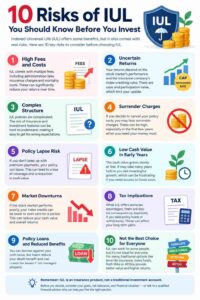
1. You do not receive the full market upside
The cap exists because the insurer is buying options with a limited hedge budget, and the floor has to be paid for somehow. The asymmetry matters more than people expect: you give up the best years, which is exactly where long run equity returns come from. Strip out the strongest handful of years and the index becomes a very ordinary asset. Add the missing dividends and the drag compounds. This matters most to anyone with a twenty year or longer horizon who could simply hold the index instead.
2. Policy charges reduce cash value regardless of performance
Premium loads, administrative charges, per thousand charges on the death benefit and rider fees are deducted from your money whether the index rises, falls or does nothing. They are heaviest in the early years, which is precisely when compounding needs the balance to be large. This is the reason a policy funded at the minimum premium often shows a cash value years later that is still below total premiums paid.
3. Cost of insurance rises as you age
The cost of insurance is priced on the net amount at risk, meaning the gap between the death benefit and your account value, multiplied by a mortality rate that climbs every year. In your forties it is a nuisance. In your seventies it can be the dominant number in the policy. Many contracts also reserve the right to raise current cost of insurance rates up to a guaranteed maximum. Buyers of the last decade have seen exactly that on older universal life blocks. If you plan to hold into your eighties, model the late years, not just the first twenty.
4. Surrender charges make early exits expensive
Surrender charges typically run ten to fifteen years and decline over time. They exist to let the insurer recover the commission and issue costs it paid up front. The practical effect is that the first several years of an IUL are close to illiquid. If there is any real chance you will need this money inside a decade, the surrender schedule alone should stop the purchase.
5. Illustrations are projections, not guarantees
The glossy column in an illustration is built on non guaranteed assumptions: a chosen crediting rate, current caps and current charges, all held flat for forty years. The guaranteed column, which assumes the minimum credited rate and the maximum charges the contract permits, usually shows the policy running out of money. Both are valid outputs of the same contract. Only one gets emailed to you.
6. Policy loans are not free money
The retirement income pitch is built on borrowing against cash value rather than withdrawing it, because loans from a policy that stays in force are generally not taxable. Loans still accrue interest. If the loan rate charged exceeds what the collateral earns, the loan balance outgrows the policy. Regulators know this: illustrations may not show the loan credited rate exceeding the loan charged rate by more than 50 basis points, precisely because the old illustrations assumed a permanent free lunch there.
7. An underfunded policy can lapse
Flexible premium is a feature until it becomes the failure mode. Skip payments, fund at the minimum, or borrow aggressively, and one day the account value cannot cover the monthly deductions. The policy lapses, the death benefit disappears, and if there was an outstanding loan you can owe income tax on gain you never received in cash. The joint Society of Actuaries and LIMRA lapse study covering 2015 to 2021, drawn from 24 companies and 33.5 million policy years of exposure, found indexed universal life was the only universal life product type with consistently higher lapse rates across policy years during the pandemic than before it. The wider academic estimate is starker: Gottlieb and Smetters, writing in the American Economic Review, report that 29% of permanent policyholders lapse within three years, 57% within ten, and that nearly 88% of universal life policies never terminate with a death benefit claim.
8. The contract is genuinely complicated
A cap, a participation rate, a spread, a floor, two or three crediting methods, a bonus that may or may not be guaranteed, two death benefit options, a rider schedule and a loan election. Complexity is not automatically bad, but it transfers power to whoever understands the document, and that is rarely the buyer. Complexity also makes comparison shopping between carriers extremely hard, which is convenient for the seller.
9. Crediting terms can change after you buy
Caps, participation rates and spreads are almost always current, not guaranteed. The insurer can lower a cap or raise a spread within the contract limits, and the guaranteed minimums are typically far below the current terms. You cannot rate shop afterwards the way you can move a brokerage account, because your health, your age and the surrender schedule have all changed since you signed.
10. Simpler options are more transparent and more liquid
A broad market index fund publishes its expense ratio, prices daily, can be sold on any business day, and shows you exactly what you own. Inside a Roth IRA or a 401(k) it also gets tax treatment that is easy to explain in one sentence. None of that is true of an IUL. For a saver whose goal is wealth building, the transparent option usually wins on the merits, not just on cost. If death benefit is the actual need, level term insurance covers it for a fraction of the premium.
Can you lose money in an IUL?
Yes. The floor protects the credited interest rate. It does not protect your money. Those are two different promises and the distinction is where most buyers get blindsided.
In a year where the index falls, a 0% floor means no negative interest is credited. Charges are still deducted. Take an account value of $100,000 with a 0% credit and $2,800 in combined cost of insurance and administrative charges. You end the year at $97,200. You did not lose money to the market. You lost it to the contract.
Ways real economic value disappears from an IUL:
- Charges in flat or down years, as above.
- Cost of insurance increases in later policy years, which can exceed the credit entirely.
- Surrender charges, which can make the cash surrender value in year three a fraction of premiums paid.
- Loan interest compounding against a policy that is crediting less than the loan rate.
- Withdrawals, which reduce the account value and can reduce the death benefit more than you expect.
- Lapse, which can convert an unpaid loan balance into taxable income.
The most expensive version of losing money is surrendering in the first few years. You paid the acquisition costs, absorbed the cost of insurance, and then hand back a surrender charge on the way out.
IUL fees and costs
| Charge | What it pays for | How it affects the policy |
|---|---|---|
| Premium load or expense charge | Distribution costs, premium taxes, state taxes | Deducted off the top, so less than your full premium ever reaches the account value |
| Cost of insurance | The mortality risk on the net amount at risk | Deducted monthly, rises with attained age, and is usually the largest long term cost |
| Administrative or policy fee | Recordkeeping and servicing | Flat monthly or annual deduction, hits small policies hardest in percentage terms |
| Per thousand charge | Issue and underwriting costs tied to face amount | Often heaviest in the first ten policy years |
| Rider charges | Chronic illness, long term care, waiver of premium, term riders | Each rider adds a deduction, so unused riders are pure drag |
| Surrender charge | Recovering unamortised acquisition cost if you leave early | Subtracted from account value on surrender, declining over the surrender period |
| Loan interest | The cost of borrowing against your own cash value | Accrues on the loan balance, and reduces the death benefit if unpaid at death |
| Index account spread or asset charge | Funding the hedge budget on some crediting strategies | Reduces the credited rate rather than appearing as a line item deduction |
There is no universal fee percentage for IUL, and any article that gives you one is guessing. Charges vary by insurer, issue age, health class, face amount, riders, death benefit option and contract generation. Ask for the schedule of charges pages from the actual policy form, not the summary.
IUL illustrations: what the numbers really mean
An illustration is a spreadsheet with a legal framework around it. In the United States that framework is the NAIC Life Insurance Illustrations Model Regulation, number 582, as applied to indexed products by Actuarial Guideline XLIX-A.
What AG 49-A does, in plain terms:
- It caps the illustrated crediting rate. For the benchmark index account, the illustrated rate cannot exceed the lower of two numbers: the arithmetic mean of rolling 25 year geometric average credited rates, and 145% of the insurer annual net investment earnings rate.
- It limits loan leverage. The illustrated loan credited rate may not exceed the illustrated loan charged rate by more than 50 basis points.
- It requires an alternate scale ledger shown alongside the illustrated scale with equal prominence, using an indexed rate roughly 100 basis points below the maximum illustrated rate.
The NAIC revised AG 49-A again on 11 December 2025, and the new requirements apply to policies sold on or after 1 April 2026. For those policies:
- Hypothetical historical index performance may only be shown for an index with at least ten years of actual market history since its inception date. Newly launched proprietary indexes with impressive back tests can no longer be displayed that way.
- Where history is shown, it covers the most recent 25 year period, or the shorter actual history if that is between ten and 25 years.
- Other historical returns are prohibited, as are tables or disclosures that compare historical returns against the maximum illustrated rate side by side.
- The illustration must state that historical index changes shown are not indicative of future returns.
If you are sitting across from an agent with an illustration in front of you, this is what to do. Ask for the guaranteed column and read it first. Ask for the alternate scale ledger, which the regulation entitles you to see. Ask for a version run at a lower crediting rate, for example 5%, and a version where you stop paying premiums at age 60. If the software supposedly cannot do that, the problem is not the software.
Cash value versus surrender value
These are not synonyms, and confusing them is the single most common reason buyers feel misled later.
| Account value (cash value) | Cash surrender value | |
|---|---|---|
| What it is | The gross balance credited inside the policy | What the insurer actually pays you to close the policy |
| Reduced by surrender charge | No | Yes |
| Reduced by outstanding loans | No | Yes |
| What appears in the sales pitch | Usually this one | Usually further down the page |
How much will I get if I surrender my IUL after 4 years?
Nobody can give you a dollar figure without your policy, and any number you see online is fiction. The answer depends on premiums paid, the account value at that date, the surrender charge for policy year four, outstanding loans, prior withdrawals, the charges already deducted and how the policy was designed and funded.
A labelled hypothetical shows the shape of the answer. Suppose you paid $12,000 a year for four years, $48,000 total, and after loads, administrative charges, cost of insurance and modest index credits the account value stands at $39,000. If the year four surrender charge is 8% of account value, that is $3,120, leaving a cash surrender value near $35,880. With a $5,000 loan outstanding, you would receive around $30,880. Paid in, $48,000. Out, roughly $30,900. Those are illustrative figures for one hypothetical policy, not a quote, and a heavily funded policy with a low face amount would look considerably better.
To get your real number, request an in force ledger from the insurer. It shows current account value, current cash surrender value, the remaining surrender schedule and the loan balance. It is free and you are entitled to it.
Educational IUL calculator
The calculator below projects a simplified IUL year by year so you can see how charges, caps and loans interact. Change the assumptions and watch what happens to the gap between premiums paid and the money you could actually walk away with.
Credited rate used each year: 8.00%. The same premiums placed in a hypothetical account earning 7.00% net of fees would reach $1,035,473 before any tax, versus a net surrender value of $917,207 here.
| Year | Age | Premium | Cumulative premium | Index credit | Charges | Loan balance | Account value | Surrender value | Net to you |
|---|---|---|---|---|---|---|---|---|---|
| 1 | 41 | $12,000 | $12,000 | $821 | $1,740 | $0 | $11,081 | $9,973 | $9,973 |
| 2 | 42 | $12,000 | $24,000 | $1,702 | $1,812 | $0 | $22,970 | $20,903 | $20,903 |
| 3 | 43 | $12,000 | $36,000 | $2,646 | $1,890 | $0 | $35,727 | $32,869 | $32,869 |
| 4 | 44 | $12,000 | $48,000 | $3,660 | $1,974 | $0 | $49,414 | $45,955 | $45,955 |
| 5 | 45 | $12,000 | $60,000 | $4,748 | $2,064 | $0 | $64,097 | $60,251 | $60,251 |
| 6 | 46 | $12,000 | $72,000 | $5,915 | $2,162 | $0 | $79,849 | $75,857 | $75,857 |
| 7 | 47 | $12,000 | $84,000 | $7,166 | $2,268 | $0 | $96,748 | $92,878 | $92,878 |
| 8 | 48 | $12,000 | $96,000 | $8,509 | $2,382 | $0 | $114,874 | $111,428 | $111,428 |
| 9 | 49 | $12,000 | $108,000 | $9,949 | $2,506 | $0 | $134,318 | $131,632 | $131,632 |
| 10 | 50 | $12,000 | $120,000 | $11,494 | $2,639 | $0 | $155,173 | $153,622 | $153,622 |
| 11 | 51 | $12,000 | $132,000 | $13,151 | $2,783 | $0 | $177,542 | $177,542 | $177,542 |
| 12 | 52 | $12,000 | $144,000 | $14,928 | $2,938 | $0 | $201,531 | $201,531 | $201,531 |
| 13 | 53 | $12,000 | $156,000 | $16,834 | $3,106 | $0 | $227,259 | $227,259 | $227,259 |
| 14 | 54 | $12,000 | $168,000 | $18,878 | $3,288 | $0 | $254,849 | $254,849 | $254,849 |
| 15 | 55 | $12,000 | $180,000 | $21,069 | $3,483 | $0 | $284,435 | $284,435 | $284,435 |
| 16 | 56 | $12,000 | $192,000 | $23,419 | $3,695 | $0 | $316,159 | $316,159 | $316,159 |
| 17 | 57 | $12,000 | $204,000 | $25,939 | $3,923 | $0 | $350,174 | $350,174 | $350,174 |
| 18 | 58 | $12,000 | $216,000 | $28,640 | $4,170 | $0 | $386,645 | $386,645 | $386,645 |
| 19 | 59 | $12,000 | $228,000 | $31,537 | $4,436 | $0 | $425,745 | $425,745 | $425,745 |
| 20 | 60 | $12,000 | $240,000 | $34,642 | $4,724 | $0 | $467,663 | $467,663 | $467,663 |
| 21 | 61 | $0 | $240,000 | $37,068 | $4,315 | $0 | $500,416 | $500,416 | $500,416 |
| 22 | 62 | $0 | $240,000 | $39,661 | $4,650 | $0 | $535,426 | $535,426 | $535,426 |
| 23 | 63 | $0 | $240,000 | $42,433 | $5,013 | $0 | $572,846 | $572,846 | $572,846 |
| 24 | 64 | $0 | $240,000 | $45,395 | $5,404 | $0 | $612,838 | $612,838 | $612,838 |
| 25 | 65 | $0 | $240,000 | $48,561 | $5,827 | $0 | $655,571 | $655,571 | $655,571 |
| 26 | 66 | $0 | $240,000 | $51,943 | $6,284 | $0 | $701,231 | $701,231 | $701,231 |
| 27 | 67 | $0 | $240,000 | $55,556 | $6,777 | $0 | $750,010 | $750,010 | $750,010 |
| 28 | 68 | $0 | $240,000 | $59,416 | $7,309 | $0 | $802,117 | $802,117 | $802,117 |
| 29 | 69 | $0 | $240,000 | $63,539 | $7,884 | $0 | $857,771 | $857,771 | $857,771 |
| 30 | 70 | $0 | $240,000 | $67,941 | $8,506 | $0 | $917,207 | $917,207 | $917,207 |
Disclaimer: This calculator is for educational purposes only. Actual IUL policy values depend on the specific insurance contract, insurer, underwriting, charges, crediting method, caps, participation rates, loans, and other policy terms. It is not an insurance quote, investment recommendation, or tax advice.
What the calculator assumes
- The index return you enter repeats every year. Real sequences are lumpy, and a constant return flatters any product with a floor.
- The participation rate is applied first, then the cap, then the floor. Your contract may order these differently.
- The premium load is deducted from each premium, then the annual policy charge and the cost of insurance, then interest is credited on the remaining balance.
- Cost of insurance grows at a fixed compounding rate. In reality it is driven by attained age mortality rates and the net amount at risk, so it accelerates faster in later years.
- Loans begin the year after contributions stop, accrue interest annually, and are modelled as secured by the policy rather than withdrawn from it. The account value keeps earning credits and the loan balance is subtracted at the end.
- The surrender charge starts at the percentage you enter and declines in a straight line to zero over the period you set.
- The comparison account ignores taxes and assumes the stated return is already net of fees, so it flatters the alternative in a taxable account and understates it inside a Roth IRA.
- No dividends are added, because index crediting is normally based on price change only.
IUL compared with the alternatives
IUL versus term life plus investing
| IUL | Term life plus a separate investment account | |
|---|---|---|
| Purpose | Permanent death benefit with cash accumulation | Temporary death benefit, separate wealth building |
| Death benefit | Lifetime, if funded and in force | Fixed term, typically 10 to 30 years |
| Cash value | Inside the contract, subject to charges | None in the policy, the account is yours |
| Investment control | Choose among index accounts the insurer offers | Full control of the portfolio |
| Costs | Load, cost of insurance, admin, riders, surrender charges | Term premium plus fund expense ratio |
| Transparency | Low, terms are current not guaranteed | High, daily pricing and published costs |
| Liquidity | Restricted during the surrender period | Sell any business day |
| Best suited to | A genuine lifelong death benefit need | Most households covering income replacement years |
IUL versus Roth IRA
| IUL | Roth IRA | |
|---|---|---|
| 2026 contribution limit | Limited by insurance rules, not a flat dollar cap | $7,500, plus $1,100 catch up at 50 and over |
| Income limits | None | Yes, phased out at higher incomes |
| Tax on growth | Tax deferred inside the contract | Tax free if qualified |
| Access to money | Withdrawals and loans, subject to policy rules | Contributions out any time, earnings subject to rules |
| Costs | Insurance charges plus fund level costs | Fund expense ratio only |
| Death benefit | Yes | No |
IUL versus 401(k)
| IUL | 401(k) | |
|---|---|---|
| 2026 employee limit | Not applicable | $24,500, plus $8,000 catch up at 50 and over, or $11,250 at ages 60 to 63 |
| Employer match | Never | Often, and it is an immediate return on contribution |
| Tax treatment | After tax premiums, tax deferred growth | Pre tax or Roth, depending on the plan |
| Creditor protection | Varies by state | Generally strong under federal law |
| Fees | Insurance charges, usually undisclosed as a percentage | Plan and fund fees, disclosed annually |
Skipping an employer match to fund an insurance policy is difficult to defend on any arithmetic. If an agent suggests it, that is your answer about the agent.
IUL versus whole life and versus an index fund
Whole life gives you guaranteed cash value, a guaranteed premium and, at mutual insurers, dividends that are not guaranteed but have a long history. It costs more per dollar of death benefit and has no index upside. IUL trades those guarantees for a shot at higher crediting. Neither is better in the abstract: whole life suits buyers who want certainty and will hold for life, IUL suits buyers who accept variability in exchange for potential.
Against a low cost index fund, an IUL is not really competing on returns and cannot win that race after charges. It is competing on the death benefit, the 0% floor and the tax treatment. If those three features are not things you specifically need, the fund is the simpler answer. Our overview of how mutual funds and index funds work covers the cost side of that comparison.
Who might reasonably own an IUL
Permanent insurance has real uses. An IUL may fit when:
- You have a death benefit need that does not expire: a special needs dependent, a spouse who would lose a pension survivor benefit, or estate liquidity so heirs are not forced to sell an illiquid asset.
- You are funding a buy sell agreement or key person coverage and need the policy to exist whenever the death occurs, not only for twenty years.
- You have already used the tax advantaged accounts available to you, including the 401(k) up to at least the match, an IRA or backdoor Roth, and an HSA if eligible, and you still have surplus cash flow you are certain you can commit for decades.
- You can fund the policy well above the minimum premium, because a heavily funded policy with the lowest allowable death benefit is a fundamentally different product from a minimum funded one.
- You are healthy enough to get a good underwriting class, which directly reduces the cost of insurance for the life of the contract.
Being high income is not on its own a reason. Neither is a general wish to pay less tax. The financial objective has to actually require permanent insurance.
Who should probably avoid IUL
- Anyone whose real need is affordable protection for their working years. Term insurance does that job for a fraction of the premium.
- Anyone with a horizon under ten to fifteen years, because the surrender schedule and front loaded charges have not been recovered yet.
- Anyone whose income is variable enough that consistent funding is uncertain.
- Anyone who might need this money for a house, a business or an emergency.
- Anyone who has not yet captured an employer match or filled an IRA.
- Anyone who cannot explain the cap, the participation rate, the cost of insurance and the surrender schedule in their own words.
- Anyone being sold on a phrase like market returns without market risk.
Sales red flags to watch for
The product is regulated and legitimate. Some of the selling is not. The complaints and arbitration claims cluster around presentation, not around the contract language. Treat these as warning signs:
- Guaranteed returns of 10% or more. Nothing about indexed crediting is guaranteed above the floor.
- The market goes up and you never lose. The floor applies to interest, not to your balance after charges.
- Only the non guaranteed column is shown, or the guaranteed column is skipped past quickly.
- Refusal or reluctance to provide the alternate scale ledger that AG 49-A requires.
- Surrender charges or the cost of insurance schedule are not discussed at all.
- Policy loans described as free, or as tax free income with no mention of lapse risk.
- No clear answer to what happens if you stop paying premiums.
- A single scenario, with no lower rate version and no stress test.
- Pressure to sign this month, or to replace an existing policy without a written comparison.
- Premium financing proposed to someone who does not have the liquidity to unwind it.
18 questions to ask before you sign
- What are the guaranteed cash values in years 1, 5, 10 and 20?
- What are the non guaranteed values at the same points, and what rate produced them?
- What is the current cap on each index account I am being offered?
- Can the cap change, and what is the contractual minimum cap?
- What is the participation rate, and can it change?
- Is there a spread or asset charge on any account, and how much?
- What is the full schedule of policy charges, including per thousand charges?
- How does the cost of insurance change at ages 60, 70 and 80?
- What happens if I miss a premium, or pay less than planned?
- What happens if the policy lapses while a loan is outstanding?
- What is the cash surrender value after 1, 4, 7, 10 and 15 years?
- What is the loan interest rate, is it fixed or variable, and is the loan participating?
- How does a loan affect the death benefit?
- What is the MEC limit on this design, and how close to it am I funding?
- What crediting rate, charges and persistency assumptions are in this illustration?
- Which numbers on this page are guaranteed and which are not?
- What commission or compensation is paid on this policy, in year one and after?
- What other policies, including term, did you compare before recommending this one?
Ask for the answers in writing. A professional will provide them. Anyone who will not has told you something useful.
Taxes and IUL
The tax treatment is genuinely favourable, which is why it gets oversold. Here is the accurate version.
- Growth: cash value accumulates tax deferred while the policy is in force.
- Death benefit: generally income tax free to beneficiaries.
- Withdrawals: from a policy that is not a modified endowment contract, they generally come out of your basis first and are tax free up to total premiums paid. Gain above basis is ordinary income.
- Loans: generally not taxable while the policy remains in force. That last clause is doing enormous work.
- Lapse or surrender with a loan outstanding: the gain in the policy becomes taxable, and the loan repayment is treated as received by you. People have been surprised by tax bills on money they spent years earlier.
- MEC status: if cumulative premiums breach the seven pay test under IRC section 7702A, the contract becomes a modified endowment contract. Distributions then follow last in first out ordering, so gain comes out and is taxed first, loans count as distributions, and taxable amounts before age 59 and a half can carry an additional 10% penalty. The death benefit stays income tax free. MEC status is generally permanent.
Never accept the phrase tax free retirement income without the qualifications. It is tax advantaged, conditional on the policy staying in force for life. Tax treatment depends on your specific contract and circumstances, so confirm anything material with a qualified tax professional.
How much does life insurance cost per $1,000?
Cost per $1,000 of coverage is a simple ratio: annual premium divided by (coverage amount divided by 1,000). A policy costing $600 a year for $500,000 of coverage works out to $1.20 per $1,000. That is arithmetic, not a market rate.
What drives the actual premium: age, health and underwriting class, tobacco use, coverage amount, policy type, term length, riders, and the individual insurer. Two people the same age can be priced very differently on the same application.
The measure is also misleading across product types. Term insurance buys pure protection for a set period, so cost per $1,000 is low. Permanent insurance funds a lifetime death benefit plus cash value, so the same measure looks high even when the policy is priced competitively. Compare like with like, or the number tells you nothing.
How much premium is needed for 1 crore life insurance?
First, the units. One crore equals 10 million in the local currency. In Pakistan that is PKR 10,000,000, in India INR 10,000,000. It is not a US dollar figure, and a rupee denominated crore and a million dollars are completely different amounts of coverage.
Premiums for a 1 crore policy depend on the country and its regulator, the currency, the insurer, your age and health, the policy type, the term and any riders. Rates in Pakistan, India and the United States are set in different markets with different mortality tables and different tax rules, so quoting one and applying it to another is meaningless. Get quotes from licensed insurers in the country where you will actually hold the policy. In the US market, a comparable conversation would be about a $1 million term policy, which is a separate pricing question with its own quotes.
Frequently asked questions
What are the dangers of IUL?
Underfunding leading to lapse, rising cost of insurance in later years, surrender charges on an early exit, loan interest compounding faster than credits, caps being reduced after purchase, and buying based on an illustration that was never a promise. The compound danger is holding the policy for eight years, losing patience, and surrendering after the charges but before the benefits.
Do rich people use IUL?
Some do, usually for estate liquidity, business succession or executive benefit arrangements, and usually after the standard tax advantaged accounts are maxed out. The point is the role the policy plays in a plan, not the owner net worth. Copying the tool without the situation is how people get hurt.
Are IULs safe to invest in?
Safe is the wrong frame. The floor removes negative index crediting, so you are not exposed to market losses in the usual sense. You are exposed to charge risk, lapse risk, loan risk, carrier credit risk and the risk that caps get cut. Those are real risks, just less visible than a falling share price.
Can you lose money in an IUL?
Yes. Charges continue in 0% credit years, surrender charges reduce what you receive on exit, loan interest compounds, and a lapsed policy can leave you with nothing plus a tax liability.
How much interest does an IUL pay?
It depends on the index result, the cap, the participation rate and the spread in your contract. Credits in a strong year are limited by the cap, credits in a bad year fall to the floor, and none of it is guaranteed above that floor. Regulators cap illustrated rates at the lower of a long run lookback average and 145% of the insurer net investment earnings rate, which gives you a sense of what is considered defensible.
What happens to an IUL when the market crashes?
Your credited rate for that segment drops to the floor, usually 0%. Charges continue to be deducted, so the account value falls. Annual reset means the next year is measured from the new lower index level, which is a genuine advantage over needing to recover a prior peak.
What happens if I stop paying my IUL?
Monthly deductions continue from the account value. If there is enough value, the policy survives for a time. When the value cannot cover the deductions, you receive a grace notice and then the policy lapses unless you pay. Any outstanding loan can trigger tax at that point.
Are IUL policy loans taxable?
Generally not while the policy is in force and is not a MEC. If the policy lapses or is surrendered with a loan outstanding, the gain becomes taxable. MEC loans are treated as distributions and taxed gain first.
What is a MEC?
A modified endowment contract, defined in IRC section 7702A. A policy funded faster than the seven pay test allows becomes a MEC, loses first in first out withdrawal treatment, and exposes distributions to gain first taxation and a possible 10% penalty before age 59 and a half.
Is IUL good for retirement?
It is rarely the first choice and occasionally a reasonable supplement. Fill the accounts designed for retirement first, then consider whether a permanent death benefit is part of your plan. Our guide on how long retirement savings actually last is a more useful starting point for that question.
How long should you keep an IUL?
If you buy one, plan on life. The economics assume decades of funding and the charges are front loaded. If you already own one and are unsure, get an in force ledger before deciding, and check whether a 1035 exchange or a reduced paid up option beats surrendering.
Why do IUL illustrations look so attractive?
Because they hold a favourable crediting rate constant for forty years, use current charges throughout, and show the non guaranteed scale by default. Change any one of those assumptions and the picture changes sharply. That is exactly why the alternate scale ledger exists.
Can an IUL cap change?
Yes. Caps, participation rates and spreads are typically declared periodically by the insurer and can move within the contractual guarantees. The guaranteed minimum cap is usually far below the current one, so find it in the contract.
Sources and references
- NAIC, Actuarial Guideline XLIX-A, adopted 11 December 2025, effective for policies sold on or after 1 April 2026: content.naic.org
- NAIC, Life Insurance Illustrations topic page: content.naic.org
- Society of Actuaries Research Institute and LIMRA, 2015 to 2021 Universal Life Insurance Lapse Rate Experience Study, November 2023: soa.org
- Daniel Gottlieb and Kent Smetters, Lapse Based Insurance, American Economic Review 111(8), August 2021: aeaweb.org
- LIMRA, US individual life insurance sales results, 2025 full year and 2026 quarters: limra.com
- IRS, 401(k) limit increases to $24,500 for 2026, IRA limit increases to $7,500, Notice 2025-67: irs.gov
- 26 US Code section 7702A, Modified endowment contract defined: uscode.house.gov
- FINRA, Insurance products overview: finra.org
What to do next
If someone has put an IUL proposal in front of you, do four things before you decide. Read the guaranteed column first and ask what happens if it comes true. Request the alternate scale ledger and a version run at a lower crediting rate. Run your own numbers in the calculator above and compare the net surrender value against the same premiums in a plain account. Then price level term insurance for the same death benefit and see what the difference costs you.
If you already own a policy, ask the insurer for an in force ledger before you make any move. Surrendering at the wrong moment is its own expensive mistake.
And if the underlying goal is simply building wealth, start with the boring infrastructure: understanding how passive and active income are actually taxed, the rules that keep long term investors out of trouble, and the numbers that tell you what you own. None of this is a substitute for advice from a licensed insurance professional or a tax adviser who has read your actual contract.