
If you live in the US, Australia, the UAE or Saudi Arabia and want to know how to invest in Pakistan Stock Exchange, the answer is short. You open a Roshan Digital Account (RDA) with a Pakistani bank online, then switch on a Roshan Equity Investment (REI) account inside that same portal, pick a broker, send money, and buy shares through the broker’s app. No trip to Pakistan. No branch visit.
Your money can also come back out. Funds in a Roshan Digital Account are fully repatriable and can be sent abroad without approval from the State Bank of Pakistan. Tax in Pakistan is simple too: 15 percent on capital gains and 15 percent on most dividends, treated as full and final, with no tax return to file and no penalty for being absent from the Active Taxpayer List.
The rest of this guide covers the parts that are easy to get wrong: what it costs, what your own country will tax, and what the rupee does to your profit on the way home.
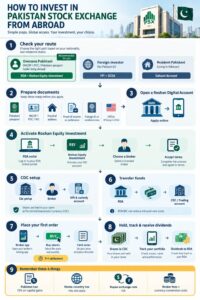
First, pick the right route
Three different routes exist, and people waste weeks on the wrong one.
| Your situation | Correct route | Can you use it from abroad? |
|---|---|---|
| Pakistani passport, NICOP, POC or NIC holder living outside Pakistan | Roshan Digital Account plus Roshan Equity Investment | Yes, fully online |
| Foreign national or foreign institution with no Pakistani ID | Foreign Portfolio Investment scheme using a Special Convertible Rupee Account (SCRA) | Yes, but heavier paperwork |
| Resident Pakistani, first time investor, small amounts | Sahulat Account with a licensed broker | No, residents only |
PSX states that foreign persons and institutions invest through the Foreign Portfolio Investment scheme, and a Special Convertible Rupee Account is mandatory for that route. The Sahulat Account can only be opened by resident Pakistani individuals. Its limit is PKR 3 million per account and it is restricted to the ready market. Plenty of beginner guides push Sahulat without mentioning that. If you live abroad, skip it.
Who qualifies for an RDA is broad. SBP lists non-resident Pakistanis holding a Pakistani passport, NICOP, POC or NIC, including people who are employed, self-employed, unemployed, homemakers, students, children and pensioners, and foreign companies and foreign nationals are eligible as well.
What you can buy once the account is open
The same portal gives you several options, not just shares. Worth knowing before you decide how much goes into the stock market.
| Option | What it is | Tax in Pakistan | Currency you hold |
|---|---|---|---|
| Roshan Equity Investment | Shares, ETFs, bonds and government securities on PSX | 15% on gains, 15% on most dividends | Rupees |
| Naya Pakistan Certificates | Fixed return government certificates | 10% withholding, full and final | PKR, USD, GBP, EUR, SAR or AED |
| Bank deposits in the RDA | Normal savings or current account | Profit is tax exempt | Rupees or foreign currency |
| Property | Residential and commercial real estate | Separate rules apply | Rupees |
PSX lists shares quoted on the Pakistani exchange, rupee deposit products, rupee denominated government debt including Naya Pakistan Certificates, T-bills, PIBs and Sukuk, and residential and commercial real estate as RDA investment options. Profit earned on RDA deposits is tax exempt, with no withholding tax deducted and no need to obtain an exemption certificate from FBR.
A number that puts this in perspective
Before you decide how much to put in shares, look at what everyone else has done.
| Position at end of August 2026 | Amount (USD million) |
|---|---|
| Naya Pakistan Certificates, Islamic | 1,332 |
| Naya Pakistan Certificates, conventional | 716 |
| Balances sitting in accounts | 729 |
| Roshan Equity Investments | 155 |
| Other, including T-bills, Sukuk, funds, property | 78 |
| Total outstanding | 3,009 |
SBP’s Roshan Digital Account statistics show 966,144 accounts opened and USD 13,906 million received by the end of August 2026, with USD 155 million outstanding in Roshan Equity Investments against USD 2,048 million in conventional and Islamic Naya Pakistan Certificates combined.
Certificates hold roughly 68 percent of outstanding balances. Shares hold about 5 percent. That is not advice either way. It simply tells you that most overseas Pakistanis so far have preferred a fixed number over a market. The equity side is growing fast though: Roshan Equity Investment balances rose from USD 59 million in December 2024 to USD 155 million in August 2026.
How to invest in Pakistan Stock Exchange: the full process
Step 1: Get your documents ready
| Document | Notes |
|---|---|
| Pakistani passport, NICOP, POC or NIC | Any one, clear scan |
| Proof of address in your country | Utility bill, tenancy contract or bank statement |
| Proof of profession or income | Job letter, payslip, business proof |
| Your foreign ID or residence visa | Emirates ID, green card, Australian licence and so on |
| FATCA form | Required for applicants living in the USA |
Step 2: Open the Roshan Digital Account
Pick one of the participating banks and fill the online form. Banks offering Roshan Equity Investment include Bank Alfalah, Dubai Islamic Bank, Faysal Bank, HBL, MCB, Meezan Bank, Samba, UBL, Bank of Punjab, HabibMetro, Allied Bank, Bank AL Habib and JS Bank. Most advertise no minimum balance and review the application within about 48 hours.
Decide here whether you want a rupee account, a foreign currency account, or both.
Step 3: Switch on the equity account inside the portal
This is not a new application. PSX describes the process as: log into your RDA, select the Roshan Equity Investment option in the portal or app, select your brokerage house and accept the terms and conditions, transfer funds to your Roshan Equity Investment (CDC) account, then start investing.
Step 4: Wait for CDC to set you up
You receive an acknowledgement email from the Central Depository Company, and within 24 hours of that, an account opening package covering your REI account with the chosen broker, your Unique Identification Number registered with NCCPL, your CDC custody account, activation of Direct Settlement Service if selected, and your CDC web login.
Two terms explained in plain words. Your UIN is the ID that tags every trade you make. Your CDC account is where the shares themselves sit, in your name, not on the broker’s books. Direct Settlement Service is free of cost for overseas Pakistanis.
Step 5: Send money in
Before your first trade you must send a fund transfer request from your Roshan Digital Account to the CDC bank account listed in your account opening package. AKD Securities says funds usually reach the trading account within about two hours.
Use your bank’s dedicated RDA SWIFT code when wiring from abroad. SBP says banks have arrangements with correspondent banks that bring transfer charges into the range of 5 to 9 dollars when the special RDA Bank Identification Code is used.
Step 6: Place your first order
Buy through the broker’s app or web terminal. Use a limit order rather than a market order, especially if you are in a very different time zone, because you will not be watching when it fills.
Settlement is now quick. From 9 February 2026, all eligible trades at PSX settle on a trade plus one (T+1) basis, replacing the earlier T+2 cycle. Note that PSX’s own Roshan Equity Investment FAQ page still describes settlement at T+2, so do not be confused if your broker’s older paperwork says the same.
Step 7: Track it and collect dividends
Corporate action entitlements are credited to your CDC account, cash dividends are made available through CDC, and you can view everything through the CDC Access web portal and app. Dividends for Roshan Digital Account holders are routed through CDC and then credited to your RDA.
Two rules that catch people out
You cannot spread your bets across brokers. Overseas Pakistanis cannot operate multiple RDAs, and one RDA can maintain one broker for the Roshan Equity Investment account. So compare brokers properly before you choose one.
If you open your RDA with an Islamic bank, your share trading is limited. AKD notes that Roshan Digital Accounts processed through Meezan, Faysal and Dubai Islamic Bank are allowed Shariah-compliant trading only. That is a feature if you want halal screening, and a restriction if you did not realise.
Trading hours in your local time
PSX’s regular market runs from 09:32 to 15:30 Monday to Thursday, and on Friday it splits into two sessions, 09:17 to 12:00 and 14:32 to 16:30. Pakistan is UTC+5.
| Where you live | Monday to Thursday session, your local time |
|---|---|
| Dubai, Abu Dhabi | 08:32 to 14:30 |
| Riyadh, Doha | 07:32 to 13:30 |
| Sydney, Melbourne (Apr to Oct) | 14:32 to 20:30 |
| Sydney, Melbourne (Oct to Apr) | 15:32 to 21:30 |
| New York (summer time) | 00:32 to 06:30 |
| New York (winter time) | 23:32 the night before to 05:30 |
| Toronto | same as New York |
| Los Angeles (summer time) | 21:32 the night before to 03:30 |
Gulf readers can trade before lunch. Australians get an afternoon and evening. North Americans get the middle of the night, which is a strong practical reason to invest for years rather than trade for days.
What it costs
| Cost | Who charges it | How much |
|---|---|---|
| Brokerage commission | Your REI broker | Not standard. PSX says your broker contacts you directly with its fee and commission structure |
| Clearing charges | NCCPL, deducted by CDC | Per NCCPL’s published schedule |
| Direct Settlement Service | CDC | Free for overseas Pakistanis |
| Inbound wire transfer | Your bank abroad | Roughly 5 to 9 dollars using the RDA BIC |
| Currency conversion spread | Your RDA bank | Usually the largest cost, and rarely quoted |
| Capital gains tax | NCCPL via CDC | 15 percent withheld on the gain until NCCPL calculates the exact figure |
Ask each broker one question in writing before choosing: is your commission inclusive of exchange and clearing charges? AKD, for example, states its commission includes PSX, SECP and NCCPL transaction charges that are generally passed on to the client separately in the industry.
Your broker’s commission is paid by CDC out of the cash you transferred from your RDA, so it comes off the balance rather than being billed to you.
Tax in Pakistan
| Income type | Rate | Do you file a Pakistani return? |
|---|---|---|
| Capital gains on shares and funds | 15% full and final | No |
| Dividends, most companies | 15% full and final | No |
| Dividends from IPPs | 7.5% | No |
| Dividends from tax exempt companies | 25% | No |
| Naya Pakistan Certificate profit | 10% full and final | No |
| Profit on RDA deposit | Exempt | No |
SBP states a full and final tax of 10 percent on NPC profit, 15 percent on capital gains, and 15 percent on dividends from mutual funds and companies other than IPPs and tax exempt companies, with IPPs at 7.5 percent and tax exempt companies at 25 percent, no penalty or doubling of the rate for absence from the Active Taxpayer List, and no need to file tax returns on dividends and capital gains. RDA holders are also exempt from withholding on cash withdrawals and account to account transfers.
For most Gulf-based readers, that 15 percent is the entire tax bill on the investment.
Tax where you live
This is general information, not advice. Rules differ by person and by treaty, so have it checked locally before you file.
| Country you live in | What you owe there | Main reporting duty |
|---|---|---|
| United States | Worldwide income is taxable. Credit generally available for Pakistani tax paid | FBAR once foreign accounts total USD 10,000 at any point in the year. Form 8938 at USD 50,000 year end or USD 75,000 at any time for a single filer in the US, and USD 200,000 or USD 300,000 for a single filer abroad |
| Australia | Residents are taxed on worldwide income, must convert all foreign income to Australian dollars, and may claim a foreign income tax offset for tax paid overseas | Declare dividends and capital gains in the annual return |
| UAE, Saudi Arabia, Qatar | No personal income tax on individuals, so Pakistani tax is usually the end of it | None locally, unless you also hold US citizenship |
One extra warning for US persons. Foreign ETFs and foreign mutual funds are generally treated as passive foreign investment companies and require a separate Form 8621 for each holding, and filing FBAR or Form 8938 does not replace that. Individually held shares are not PFICs. If you are American, that usually argues for buying shares directly rather than a Pakistani ETF, because the paperwork cost can exceed the return on a small position.
The rupee matters more than your stock picks
In September 2020, when the RDA launched, the US dollar traded around PKR 165.5 to 166.2. Through 2026 the rate has ranged between 277.49 and 282.80, averaging about 278.89. A rupee asset held across those six years lost roughly 40 percent of its dollar value from currency alone.
Recent years have been kinder. The KSE-100 closed FY2025-26 at 180,302, up 44 percent in rupee terms and 46 percent in dollar terms, with cumulative three year returns of 335 percent in rupees and 347 percent in dollars since FY24. The index settled at 170,884.58 on 18 September 2026. Dollar returns beating rupee returns means the currency helped overseas investors rather than hurting them in that window. Plan for both possibilities.
Here is the same rupee gain under three currency outcomes. Assume you convert USD 10,000 at 278, giving PKR 2,780,000, and the portfolio rises 20 percent in rupee terms. The gain of PKR 556,000 less 15 percent capital gains tax of PKR 83,400 leaves PKR 3,252,600.
| If the rupee | Exit rate | You get back | Dollar return |
|---|---|---|---|
| Stays flat | 278.0 | USD 11,700 | +17.0% |
| Weakens 8% | 300.2 | USD 10,834 | +8.3% |
| Weakens 15% | 319.7 | USD 10,174 | +1.7% |
These are arithmetic examples, not predictions. The lesson holds whatever numbers you use: your currency assumption moves the result more than your stock selection does.
Shares or certificates? Work out the hurdle first
Your RDA offers both, so compare them honestly.
SBP’s rate card shows annualised NPC rates of 6.75 to 7.75 percent in USD across three months to five years, 11.75 to 12.75 percent in PKR, 6.75 to 8.00 percent in GBP, 4.75 to 6.25 percent in EUR, and 6.50 to 7.50 percent in both SAR and AED. Those rates apply to issuance from 1 June 2026, so check the live page before buying. Gulf readers should note the SAR and AED options, which let you hold a Pakistani government instrument in your own salary currency.
| PSX shares (REI) | Naya Pakistan Certificates | |
|---|---|---|
| Return | Not fixed, can be negative | Fixed rate for the tenor |
| Currency | Rupees only | Your choice of six currencies |
| Pakistani tax | 15% on gains and dividends | 10% withholding, full and final |
| Access to your money | Sell any trading day, settles T+1 | Early encashment allowed, but no profit if encashed inside three months, and the rate drops to the nearest shorter tenor |
| Effort required | Ongoing research and monitoring | Set and forget |
Now the hurdle. Take the five year USD certificate at 7.75 percent gross. After the 10 percent tax that is about 6.98 percent a year in dollars, which compounds to roughly 40 percent over five years with no rupee exposure. For PSX shares to beat that in dollar terms, assuming the rupee weakens 5 percent a year, the portfolio needs around 12.3 percent a year in rupee terms after capital gains tax. Recent years cleared that comfortably. It is still a bar, not a promise.
One caution on NPC minimums, because sources disagree. SBP’s NPC FAQ page refers to a minimum investment of USD, GBP or EUR 5,000 or PKR 100,000, and says partial encashment cannot take you below that amount. Meezan Bank currently advertises a minimum of 1,000 in USD, GBP, EUR, SAR or AED with multiples of 500, and PKR 10,000 with multiples of 1,000. Confirm the current figure with your own bank rather than budgeting off any article.
How much should you start with
There is no published minimum for a Roshan Equity Investment account. The real floor is set by costs. A USD 500 transfer with a 9 dollar wire fee has lost 1.8 percent before you buy anything, and the conversion spread sits on top. Send fewer, larger amounts rather than small monthly ones.
If you want spread rather than three company names, ETFs trade on PSX and there is a dedicated odd lots market for ETFs, which helps small orders. US readers, remember the PFIC point above before choosing an ETF.
Risks you should price in
Currency risk is the first, covered above. The second is how quickly this market moves. Within FY26 the KSE-100 reached 189,167 on 23 January 2026 before falling, bottoming at 146,480 on 9 March 2026, a 29 percent swing across the year. That is a fall of about 22.6 percent from peak to trough. On 2 March the index recorded its largest ever single day decline, losing 16,089 points or 9.57 percent to close at 151,973. The trigger was regional conflict and an oil price spike, which is a permanent feature of an oil importing market rather than a one off.
Concentration is the third. Foreign investors were net sellers of roughly USD 895 million during FY26 even as the index rallied, and a small group of heavyweights drove a disproportionate share of the gains. Buying “the index” here means buying a few banks and energy names.
Finally, plan for moving back. If you return to Pakistan permanently your residential status changes, so you must open a new CDS account on your CNIC and submit a written request to CDC to transfer your securities, along with your CNIC copy, cancellation of NICOP or POC, and proof of cancellation of your employment or visa.
Common mistakes and what to do instead
| Mistake | Better approach |
|---|---|
| Waiting for a “better” rupee rate before starting | Decide an amount and a schedule, then stick to it |
| Acting on WhatsApp or Telegram tips | Read company financials and disclosures on PSX |
| Picking a broker without comparing fees | Get the fee schedule in writing first, since you are locked to one |
| Putting the whole Pakistan allocation into shares | Split between equities and certificates deliberately |
| Ignoring home country filing duties | Check FBAR, Form 8938 or ATO obligations before you invest |
| Sending small amounts frequently | Consolidate transfers to reduce fee drag |
| Trying to day trade from a different time zone | Use limit orders and hold for years, not days |
Frequently Asked Questions
-
How do I invest in the Pakistan Stock Exchange from abroad?
Open a Roshan Digital Account online with a designated Pakistani bank, activate the Roshan Equity Investment option in the portal, pick a broker, transfer funds to your CDC account, and buy shares through the broker's app. -
Do I need to visit Pakistan?
No. The RDA lets non-resident and overseas Pakistanis open an account remotely through an entirely digital and online process. -
Can I take my money out of Pakistan later?
Yes. RDA funds can be remitted back without regulatory approval. Confirm your bank's process and charges for the outgoing transfer. -
How much tax will I pay in Pakistan?
15 percent on capital gains and on most dividends, both full and final, with no Pakistani return to file. -
Will my own country tax me as well?
If you are tax resident in the US or Australia, yes, with relief usually available for the Pakistani tax already paid. In the UAE, Saudi Arabia and Qatar, individuals generally pay no local tax on this income. -
Is there a minimum investment?
No published minimum for the equity account. Very small transfers are inefficient because of wire fees and conversion costs. -
Can overseas Pakistanis use a Sahulat Account?
No. It is for resident Pakistani individuals only. -
How long do trades take to settle?
One business day, since PSX moved to T+1 in February 2026. -
Can I invest only in Shariah-compliant shares?
Yes. Opening your RDA with an Islamic bank restricts REI trading to Shariah-compliant securities, and PSX publishes Islamic indices and screening guidance. -
Can I invest PKR 10,000 in PSX?
Yes, PKR 10,000 can be used as a starting amount for eligible investments, but the amount you can buy depends on the security price, trading rules and applicable costs. A small portfolio may also have limited diversification. -
Is PSX safe for beginners?
PSX operates within Pakistan’s regulated capital-market framework, but that does not mean investments are risk-free. Individual securities can lose value, so beginners should understand the risks before investing.
Before you send the first transfer
Check the tax and reporting rules for the country you actually live in, not just Pakistan’s. Ask your chosen broker for its fee schedule in writing, because switching later is not simple. Verify the current NPC rates and minimums on SBP’s own page rather than any secondary source, including this one. And decide in advance how much of your Pakistan allocation belongs in certificates and how much in shares, so the split is a plan rather than a reaction to the next 9 percent down day.
Verify these figures yourself
Numbers in this market change monthly, so check the primary sources before acting:
- State Bank of Pakistan, Roshan Digital Account key statistics for account numbers, inflows and the equity versus certificate split, updated monthly
- State Bank of Pakistan, Roshan Digital Accounts for eligibility, current Naya Pakistan Certificate rates and bank charge schedules
- Pakistan Stock Exchange, Roshan Equity Investment (REI) for the account opening process and the current broker and bank lists
- Pakistan Stock Exchange, trading hours for session timings and the Friday split
- NCCPL for clearing charges and settlement rules
- CDC Pakistan, Roshan Digital Account FAQs for custody, dividend routing and capital gains tax withholding
- SECP to confirm a broker’s licence before you fund an account
- Australian Taxation Office, foreign and worldwide income if you are an Australian tax resident
- IRS, Form 8938 questions and answers if you are a US person


