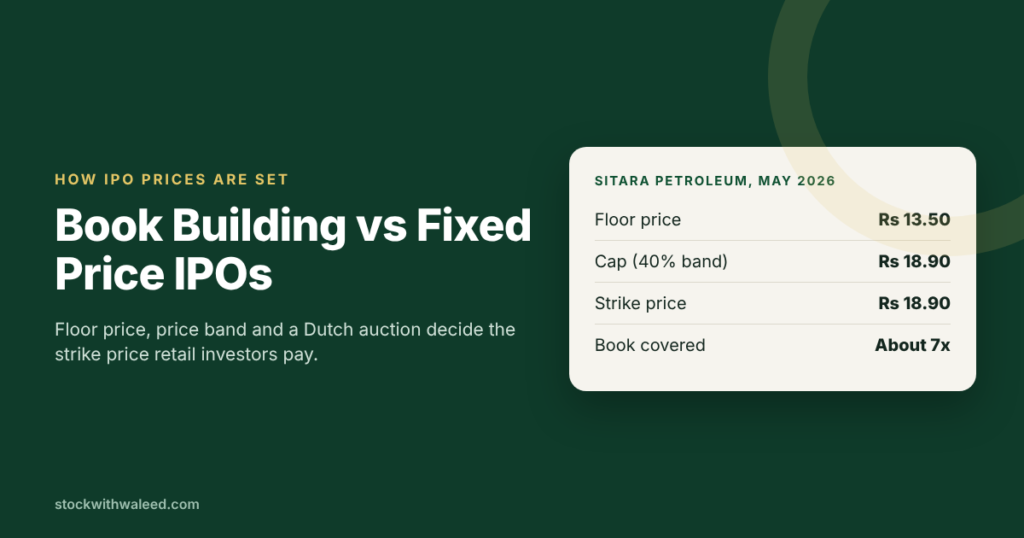
In a fixed price IPO, the company sets the share price before anyone applies, and you know exactly what you’ll pay. In a book building IPO, the company sets only a floor price and a price band, institutions and wealthy investors bid over two days, and the final “strike price” comes out of that auction. Retail investors then apply at that strike price. Nearly every main board IPO on PSX in 2026 used book building, typically with 75% of the shares going through the book and 25% offered to the general public.
For a retail investor, the practical difference is this: with book building you don’t know your price until the bidding ends, but the price has been tested by professional money first.
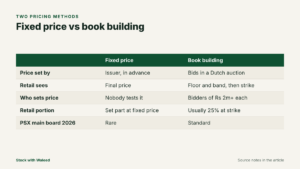
The two methods side by side
| Fixed price IPO | Book building IPO | |
|---|---|---|
| Who sets the price | The issuer and its consultant, in advance | The market, through bids in a Dutch auction |
| What retail sees in the prospectus | The final price | A floor price and a maximum price band; strike price comes in a supplement |
| Who takes part in price discovery | Nobody; price is fixed | Eligible investors bidding at least Rs 2 million each |
| Retail portion | Whole offer or a set part of it, at the fixed price | Usually 25% of the IPO, at the strike price |
| Risk of mispricing | Higher; the price may be too high or too low | Lower, though not zero |
| Typical on PSX main board in 2026 | Rare | Standard |
How book building works on PSX
The steps below come from the Sitara Petroleum Service Limited prospectus (April 2026) and PSX’s book building notices, which follow the Public Offering Regulations, 2017 as amended in 2025.
1. The issuer sets a floor price and a price band
The floor price is the minimum price per share. The price band is the maximum above the floor that bids can go. Sitara Petroleum set a floor of Rs 13.50 and a maximum band of 40%, so bids could go up to Rs 18.90. Bands vary by issue: Select Technologies’ 2026 band ran from Rs 28 to Rs 42, 50% above its floor (Mettis Global). SECP’s July 2025 amendments gave the consultant to the issue the job of determining the price band using valuation models, with the justification disclosed in the prospectus (Business Recorder, July 18, 2025).
2. Eligible investors register
Bids are placed through “Eligible Participants”: securities brokers, mutual funds, scheduled banks and development finance institutions that are clearing members of NCCPL. This replaced the older single “book runner” model in 2025. Investors register with PSX’s book building system, starting three days before bidding and closing at 3 pm on the last bidding day.
3. Bidding runs for at least two working days
Bidding is open from 9 am to 5 pm. The minimum bid is Rs 2 million, up from Rs 1 million before the 2025 amendments. Rules from recent prospectuses:
- A bid can’t be more than 10% above the prevailing indicative strike price, within the overall band.
- Bids can be revised upward but not downward in price or volume. If you raise the price, you can reduce the volume as long as the total bid amount stays the same.
- Bids can’t be withdrawn.
- One investor, one bid application (except upward revisions). Consolidated bids on behalf of others are prohibited.
- Step bids (a series of limit bids at increasing prices) are allowed, with each step at least Rs 2 million.
4. The strike price is found by Dutch auction
All bids are sorted from highest price to lowest. The system goes down the list adding up shares until the total equals the book building portion. The price where that happens is the strike price, and everyone at or above it is a successful bidder. The live “indicative strike price” during bidding is what people watch on PSX’s book building screen.
5. A supplement announces the result
Within one working day of bidding closing, the issuer publishes a supplement to the prospectus with the strike price, the underwriters of the retail portion, the category-wise breakup of successful bidders, and the retail subscription dates.
6. Retail investors apply at the strike price
The remaining 25% goes to the general public through PSX e-IPO and CDC e-IPO, usually a few days later. Physical applications ended on September 1, 2025. See how to apply.
A simple Dutch auction example
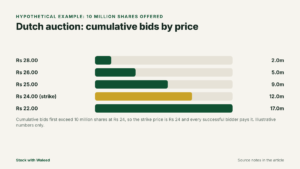
This is a made-up example to show the mechanics. Suppose a company offers 10 million shares in book building with a floor of Rs 20 and a cap of Rs 28. Bids come in like this:
| Bid price (Rs) | Shares bid | Cumulative shares |
|---|---|---|
| 28.00 | 2,000,000 | 2,000,000 |
| 26.00 | 3,000,000 | 5,000,000 |
| 25.00 | 4,000,000 | 9,000,000 |
| 24.00 | 3,000,000 | 12,000,000 |
| 22.00 | 5,000,000 | 17,000,000 |
The cumulative total first reaches 10 million at Rs 24, so the strike price is Rs 24. Bidders at Rs 24 and above are successful, and everyone pays Rs 24, including those who bid Rs 28. The book here is 1.7 times covered (17 million ÷ 10 million). Retail investors then apply at Rs 24.
What 2026 book building results looked like
| IPO | Floor (Rs) | Strike (Rs) | Book building demand | Note |
|---|---|---|---|---|
| Pak-Qatar General Takaful (Jan 2026) | 10.00 | 14.00 | 21x oversubscribed | Struck at the 40% cap |
| Sitara Petroleum (May 2026) | 13.50 | 18.90 | About 7x | Cap reached; book filled in 8 minutes |
| Wahdat Poultry Farm (Apr 2026) | 12.00 | 18.00 | 5.2x | Strike 50% above floor |
| Service Long March Tyres (May 2026) | Not covered here | 19.95 | 16.7x (Rs 69.38bn vs Rs 4.17bn) | Subscribed in 5 seconds |
| Select Technologies (Jun 2026) | 28.00 | 34.00 | 3.2x | 436 bidders, 295 successful |
Sources: ProPakistani and Middle East Insurance Review (Pak-Qatar); ProPakistani (Sitara); The News (Wahdat); Arif Habib Limited letter (Service Long March); Arif Habib Limited letter (Select).
What this means for retail investors
You won’t know the price at first
The prospectus shows a range. Budget for the maximum (the cap) if you want to be sure you can pay. Sitara’s cap was Rs 18.90, and that’s exactly where it struck.
A strike at the cap means heavy demand, not a bargain
When the book hits the cap, institutions were willing to pay more than the issuer allowed. That often spills over into retail demand too, which means heavier oversubscription in the public portion and smaller allotments. Read how allotment works.
A strike near the floor is a signal too
If professional bidders weren’t keen to pay above the floor, ask why before applying.
The book shows who’s buying
The supplement lists successful bidders by category. In Select Technologies’ book, high-net-worth individuals took 30.5 million of the 66.7 million book building shares, mutual funds 10.5 million and corporates 10.2 million. A book dominated by long-term institutions tells a different story from one dominated by short-term individuals.
Who actually bids: a category breakdown
The supplement to the prospectus lists how many shares went to each type of investor. Service Long March Tyres’ book building on May 18–19, 2026 drew 2,378 bidders, of whom 2,375 were successful (source):
| Category | Shares allocated | Share of book |
|---|---|---|
| High net worth individuals | 124,297,285 | 42.5% |
| Mutual funds | 67,896,229 | 23.2% |
| Other institutions and corporates | 48,658,042 | 16.6% |
| Commercial banks | 17,258,150 | 5.9% |
| TREC holders (brokers) | 16,534,752 | 5.7% |
| Insurance companies | 9,029,734 | 3.1% |
| Development financial institutions | 5,504,323 | 1.9% |
| Investment companies | 2,505,110 | 0.9% |
| Employees’ provident and pension funds | 619,903 | 0.2% |
| Total | 292,303,528 | 100% |
Individuals bidding at least Rs 2 million took the largest slice. Mutual funds, which manage savings for many retail investors and tend to hold for longer, took nearly a quarter. Comparing these mixes across IPOs tells you who set the price.
Watching the indicative strike price
During the two bidding days, PSX’s book building system shows an indicative strike price: the price at which the book would clear if bidding stopped at that moment. A few patterns are worth knowing:
- It usually starts at or near the floor and climbs as bids arrive.
- Because a bid can be at most 10% above the prevailing indicative strike price, the price climbs in steps rather than jumping straight to the cap.
- Hot issues hit the cap fast. Pak-Qatar General Takaful struck at its 40% cap; Sitara Petroleum’s book was filled within 8 minutes, and Service Long March Tyres’ within 5 seconds.
- Bidders can keep revising upward until 5 pm on the last day, so the indicative price can still move in the final hours.
Lessons from older book-built IPOs
Book building doesn’t always produce a premium. When PSX itself offered shares in June 2017 at a floor of Rs 28, the book building portion was initially undersubscribed, and SECP allowed a one-day extension of the bidding period (Profit). At the other extreme, Service Global Footwear’s 2021 book set the strike price at Rs 53.20, the full 40% above its Rs 38 floor, and the retail portion that followed was oversubscribed 4.9 times (Pakistan Observer). Panther Tyres’ 2021 book was oversubscribed 4.37 times, with a strike of Rs 65.80 against a floor of Rs 47 (Profit).
The common thread: the book tells you about demand at the time of the offer. It doesn’t tell you how the business will perform afterwards.
Why issuers prefer book building
| For the issuer | Fixed price IPO | Book building IPO |
|---|---|---|
| Risk of leaving money on the table | High if priced low | Lower; demand can push the price up to the cap |
| Risk of a failed issue | High if priced high | Lower; floor and underwriting give a backstop |
| Marketing to institutions | Less incentive to engage | Institutions engage because they set the price |
| Complexity and cost | Simpler | More steps; registration, bidding, supplement |
What changed in 2025
SECP’s amendments, approved in July 2025, changed several book building rules (Business Recorder):
- The single book runner was replaced by “Eligible Participants”, so brokers, mutual funds and banks can submit bids directly.
- Minimum bid raised from Rs 1 million to Rs 2 million.
- The option of 100% book building (no separate retail portion at the outset) was withdrawn, to encourage independent underwriting of the retail portion.
- A clawback lets the retail allocation rise by up to 10% when retail investors oversubscribe.
- The consultant to the issue sets the price band using valuation models and must justify it in the prospectus.
- Physical applications were discontinued from September 1, 2025.
Before these changes, issues like Service Global Footwear (2021) put 100% of the offer into book building and then released 25% to retail. That structure is no longer available for new issues.
Limit bids, step bids and margin money
Bidders in the book have a few tools, defined in recent prospectuses:
- Limit bid: the bidder names the maximum price (up to the cap) they’ll pay. If the strike price ends up at or below their limit, they’re successful and pay the strike price.
- Step bid: a series of limit bids at rising prices, for example Rs 2 million at Rs 30, another Rs 2 million at Rs 32 and another at Rs 34. Each step must be at least Rs 2 million.
- Margin money: securities brokers participate with 100% margin money deposited with NCCPL for their proprietary and client bids. Bidders put up the cash, which is part of why the book is a serious signal.
Because bids can’t be withdrawn or reduced, a bidder who places a high limit price is committed if the book clears there. That’s different from a retail application, where you only commit at a known strike price.
How the floor price is justified
The prospectus has a valuation section (Section 4A in Sitara Petroleum’s) where the consultant to the issue explains the floor price. Typical methods include discounted cash flow, dividend discount models and comparisons with listed peers on price to earnings or price to book. After the 2025 amendments, the consultant must also justify the price band. Read this section critically: it’s written to support the price, so check the assumptions (growth rates, margins) against the company’s own history in the financial summary.
What the supplement tells retail investors
The supplement, published within one working day of bidding closing, is short but useful. It gives:
- The strike price and the issue price for retail (the same)
- Names of underwriters of the retail portion, with the number of shares, underwriting fee and take-up commission
- The category-wise list of successful bidders and shares allocated to each category
- Retail subscription dates
Sitara Petroleum’s supplement, for example, named Arif Habib Limited as underwriter of all 42 million retail shares at a 1.5% fee and 0.10% take-up commission. If retail investors don’t take up the shares, the underwriter must.
Is fixed price better for retail?
Fixed price is simpler: you know the price from the start. But the price hasn’t been tested, so it can be set too high (you overpay) or too low (heavy oversubscription and tiny allotments). Book building moves that risk onto professional bidders, who put up at least Rs 2 million each and can’t withdraw. For most retail investors, the book building result is the single most useful public signal about an IPO, as long as you read it as information, not a promise.
Frequently asked questions
Can a retail investor bid in book building?
Yes, if you can bid at least Rs 2 million through an Eligible Participant. Individuals with that amount can register as bidders. Otherwise, you apply in the retail portion.
Does the retail portion pay the same price as institutions?
Yes. Retail applicants pay the strike price, the same price successful bidders pay.
Where can I watch book building live?
PSX runs the book building system and publishes notices on its data portal. Brokers and financial news sites usually report the indicative strike price during bidding.
Next: how to read an IPO prospectus in 15 minutes.
For education only, not investment advice. Rules described here follow 2026 prospectuses and SECP’s 2025 amendments; check the prospectus of each issue.


