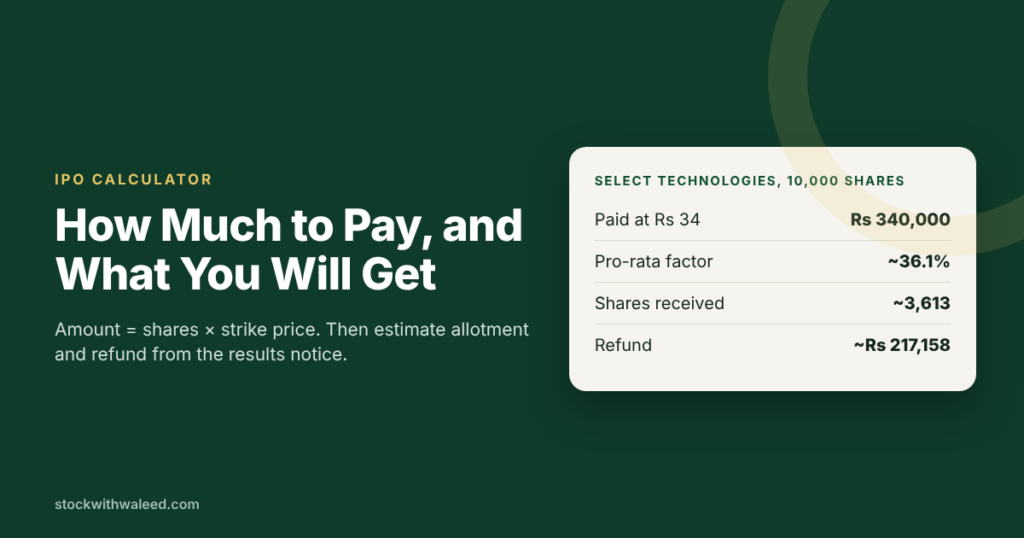
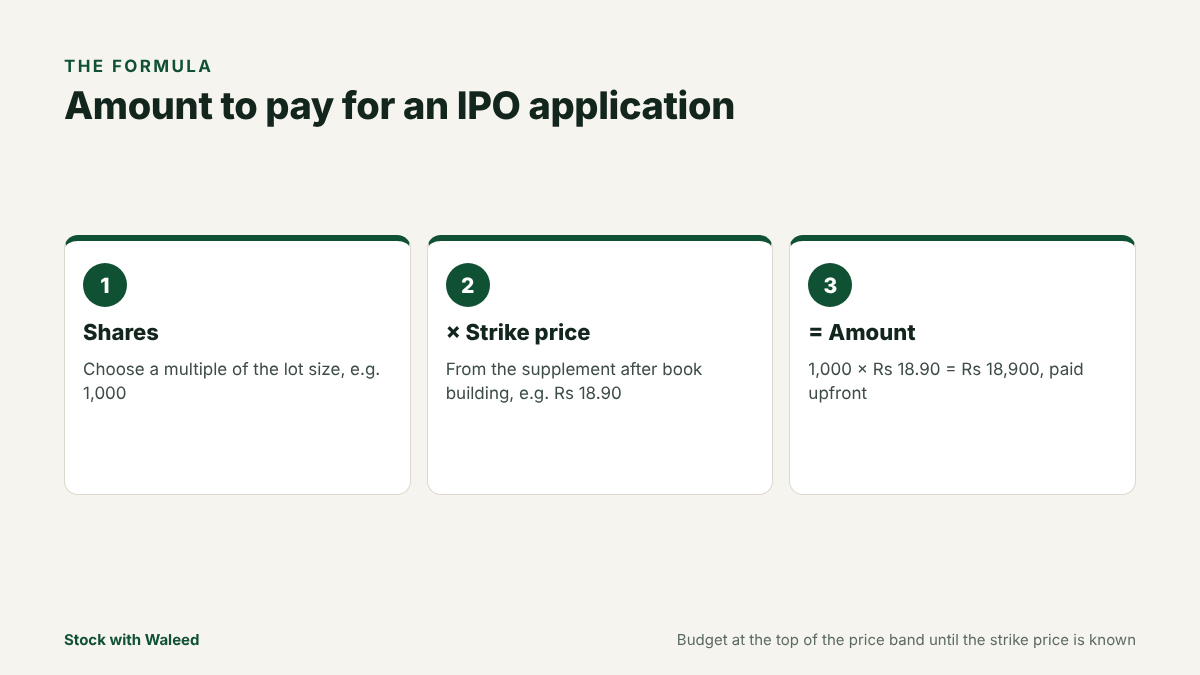
The amount you pay for an IPO application in Pakistan is number of shares × strike price. Apply for 1,000 shares at a strike price of Rs 18.90 and you pay Rs 18,900 upfront. What you actually receive depends on the allotment basis announced after the subscription closes, and any amount for shares you don’t get is refunded. The calculator below works out both: what you pay now, and an estimate of what you’ll get once the results are out.
Part 1: How much you pay
You pay the full amount when you apply, at the strike price discovered in book building. In 2026, applications were made in 500-share lots, as the subscription result notices on the PSX data portal show. Always confirm the lot size in the prospectus.
| Strike price (Rs) | 500 shares | 1,000 shares | 1,500 shares | 2,000 shares | 5,000 shares |
|---|---|---|---|---|---|
| 14.00 | 7,000 | 14,000 | 21,000 | 28,000 | 70,000 |
| 18.90 | 9,450 | 18,900 | 28,350 | 37,800 | 94,500 |
| 19.95 | 9,975 | 19,950 | 29,925 | 39,900 | 99,750 |
| 34.00 | 17,000 | 34,000 | 51,000 | 68,000 | 170,000 |
These strike prices are from real 2026 IPOs: Pak-Qatar General Takaful (Rs 14), Sitara Petroleum (Rs 18.90), Service Long March Tyres (Rs 19.95) and Select Technologies (Rs 34).
Before the strike price is known, budget at the top of the price band. Sitara Petroleum’s floor was Rs 13.50 and its cap Rs 18.90. It struck at the cap, so anyone who budgeted at the floor was short by 40%.
Part 2: Estimating your allotment
After the subscription closes, the lead manager publishes the number of applications in each size bracket and the basis of allotment. There are three common outcomes for a bracket:
- Allotted in full: you get every share you applied for.
- Pro-rata: everyone in the bracket gets the same percentage.
- Balloting: a random draw decides which applications get shares.
Some issues also refund an entire bracket. Why this happens is explained in IPO allotment in Pakistan.
The pro-rata formula
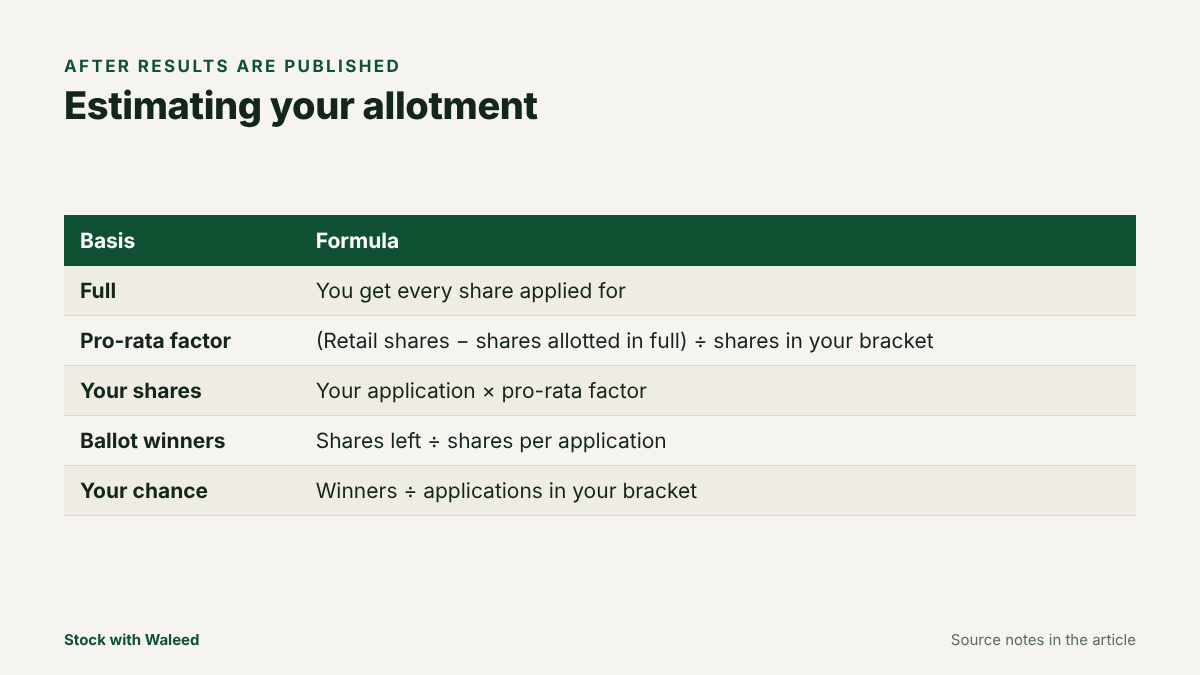
Pro-rata factor = (retail shares offered − shares allotted in full to smaller brackets) ÷ shares applied for in your bracket
Your shares ≈ your application × pro-rata factor
Worked example 1: Select Technologies (pro-rata)
Figures from the July 2026 subscription notice:
- Retail shares offered: 22,222,222
- Applications up to 2,000 shares (allotted in full): 1,695,500 + 3,350,000 + 1,368,000 + 6,638,000 = 13,051,500 shares
- Applications above 2,000 shares (pro-rata): 25,382,000 shares
Shares left = 22,222,222 − 13,051,500 = 9,170,722. Factor = 9,170,722 ÷ 25,382,000 ≈ 36.1%.
If you applied for 10,000 shares at Rs 34, you paid Rs 340,000. You’d receive about 3,613 shares (Rs 122,842 worth) and get roughly Rs 217,158 back.
The balloting formula
Number of winners = shares left ÷ shares per application in your bracket
Your chance ≈ number of winners ÷ applications in your bracket
Worked example 2: Pak-Qatar General Takaful (balloting)
Figures from the February 2026 subscription notice:
- Retail shares offered: 7,500,000
- Applications up to 1,500 shares (allotted in full): 1,171,000 + 2,873,000 + 1,837,500 = 5,881,500 shares
- 2,000-share applications (balloting): 3,349 applications
- Above 2,000 shares: refunded
Shares left = 1,618,500. Winners ≈ 1,618,500 ÷ 2,000 ≈ 809. Chance ≈ 809 ÷ 3,349 ≈ 24%.
So a 2,000-share application (Rs 28,000 at Rs 14) had about a one-in-four chance of getting 2,000 shares, and otherwise got a full refund. A 1,500-share application (Rs 21,000) was certain to get 1,500 shares.
Worked example 3: Service Long March Tyres (heavy pro-rata)
From the June 2026 notice: 97,434,510 retail shares; 34,771,500 taken by applications up to 2,000 shares; 704,400,000 applied for above 2,000. Factor ≈ 62,663,010 ÷ 704,400,000 ≈ 8.9%.
A 20,000-share application at Rs 19.95 meant paying Rs 399,000 for roughly 1,779 shares, with about Rs 363,500 refunded. Someone who applied for 2,000 shares (Rs 39,900) received all 2,000, more than the person who applied for ten times as much.
How to use the calculator with a real notice
- Open the IPO’s subscription results notice from its PSX PRIDE page or the PSX data portal.
- Enter the strike price and your application size in Step 1.
- In Step 2, choose the basis the notice gives for your bracket.
- Enter the retail shares offered (the “issue size” in the notice).
- Add up the shares column for every bracket the notice says is “allotted in full”, and enter the total.
- For pro-rata, enter the shares column for your bracket. For balloting, enter the shares per application and the number of applications in your bracket.
- Click Calculate.
Before results: a planning table
Before the window closes, you can’t know the cut-off, but you can see how much is at stake at each size. At a strike price of Rs 25, for example:
| Application | Amount paid | If allotted in full | If pro-rata at 30% | If pro-rata at 10% |
|---|---|---|---|---|
| 1,000 shares | Rs 25,000 | 1,000 shares | 300 shares | 100 shares |
| 2,000 shares | Rs 50,000 | 2,000 shares | 600 shares | 200 shares |
| 5,000 shares | Rs 125,000 | 5,000 shares | 1,500 shares | 500 shares |
| 10,000 shares | Rs 250,000 | 10,000 shares | 3,000 shares | 1,000 shares |
The pro-rata percentages here are hypothetical, chosen to fall within the 2026 range shown in our allotment guide (about 9% for Service Long March Tyres to about 85% for Wahdat Poultry).
What the numbers teach
- In popular IPOs, applying big mostly means locking up money. In the Service Long March Tyres example above, over 90% of a large application came back as a refund.
- The guaranteed bracket moves. It was up to 1,500 shares for Pak-Qatar, up to 2,000 for Select and Service Long March, and only 500 for LSE SPAC-II.
- Money is idle in the meantime. Refunds are due within ten working days of the subscription close under PSX listing regulations. See IPO refunds.
Notes on the calculator
- It works through a normal form submit; no app or login needed.
- For pro-rata, it applies the factor to your whole application and rounds down. Registrars may apply rounding to lots or other refinements.
- For balloting, it shows your chance and a probability-weighted expected number of shares. In reality you get either the full application or nothing.
- It doesn’t include broker commission or tax, which apply when you sell, not when you subscribe.
Frequently Asked Questions
-
Does the calculator work before the strike price is known?
Yes. Enter the cap of the price band to see the most you might pay. -
Why does a balloted bracket show fractional expected shares?
It's an average across all applicants in the bracket. You personally either win the full application or receive nothing and get a full refund. -
Is my data saved?
The site doesn't store your inputs. The numbers appear in the page address after you click Calculate, so you can bookmark or share a calculation.
New to IPOs? Start with how to apply for an IPO in Pakistan and the beginner checklist.
Calculations use figures from official PSX data portal notices. Results are estimates, not a guarantee of allotment, and nothing here is investment advice.


