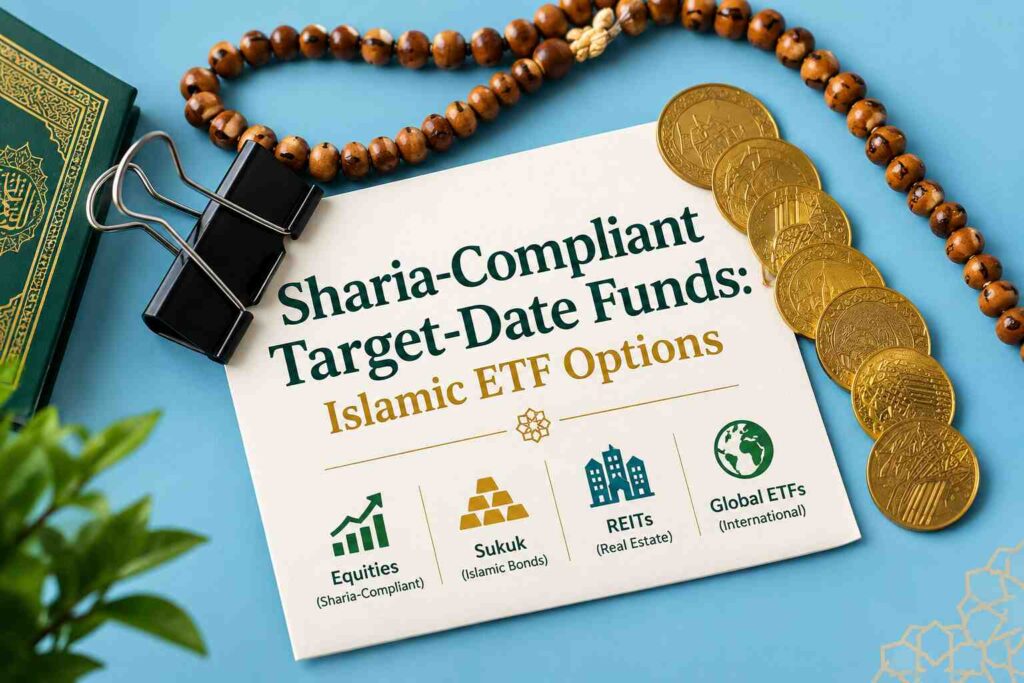
No US-listed Sharia-compliant target-date ETF exists as of October 2026. The closest product is a set of Sharia-compliant target date mutual funds from SP Funds, and they are built entirely from Sharia-compliant ETFs. The lineup is SPTAX and SPTMX for 2030, SPTBX and SPTNX for 2040, and SPTCX and SPTOX for 2050, with investor and institutional share classes for each year.
So the practical answer has two parts. If you want a single “set it and forget it” fund that shifts from growth to safety as retirement approaches, the SP Funds series is the only US option found during research. If you specifically want an ETF, you have to build the glide path yourself from halal ETFs such as SPUS, HLAL, SPWO and SPSK.
The short answer
| What the investor is looking for | Available? | Example |
|---|---|---|
| Sharia-compliant target-date funds | Yes | SP Funds 2030, 2040 and 2050 Target Date Funds |
| Target-date fund that uses ETFs | Yes | SP Funds Target Date Funds |
| Sharia-compliant ETFs | Yes | SPUS, SPSK, SPRE, SPTE, SPWO |
| Sharia-compliant target-date ETF itself | Very limited | No clear U.S.-listed example identified |
| Islamic target-date funds outside the U.S. | Yes | Principal Islamic RetireEasy funds in Malaysia |
The distinction matters because an ETF and a target-date fund are two different characteristics. A fund can use ETFs as its underlying investments without being an ETF itself.
What is a target-date fund?
A target-date fund is designed around a particular future year, usually the year an investor expects to retire.
For example, someone expecting to retire around 2050 might choose a 2050 target-date fund. The fund’s portfolio is then managed according to a glide path, which gradually changes the asset allocation as the target year approaches.
A typical conventional target-date fund starts with a larger allocation to growth-oriented assets and gradually increases its allocation to bonds and other relatively defensive assets.
That creates a problem for Muslim investors because conventional bonds are generally based on interest-bearing debt.
A Sharia-compliant target-date fund has to solve that problem differently. Instead of simply replacing stocks with conventional bonds, it can use instruments such as sukuk, Sharia-compliant equities, Islamic REITs, cash that does not generate interest, and other permissible investments.
The SP Funds prospectus specifically describes this approach. Its target-date funds use an asset-allocation strategy that changes as the target date approaches, while seeking exposure primarily through funds following a Sharia-compliant investment strategy.
What are the Sharia-compliant target-date funds available from SP Funds?
The most clearly documented U.S. options are the SP Funds Target Date Funds.
The February 2026 SEC prospectus lists three target dates:
| Target-date fund | Investor ticker | Institutional ticker |
|---|---|---|
| SP Funds 2030 Target Date Fund | SPTAX | SPTMX |
| SP Funds 2040 Target Date Fund | SPTBX | SPTNX |
| SP Funds 2050 Target Date Fund | SPTCX | SPTOX |
The SEC filing confirms these fund names and share-class tickers.
These funds are designed for investors who expect to retire around the target year. The fund’s stated objective is to seek a high level of total return through the target date and, after that date, primarily seek current income and secondarily capital appreciation.
Why there is no Sharia target date ETF yet
Target date ETFs do exist in the conventional market. BlackRock’s iShares LifePath series is one example: ITDF is an actively managed fund-of-funds that holds equity, fixed income and money market ETFs, shifting the mix as 2050 approaches. Its underlying holdings show why none of these qualify. The 2050 fund holds the iShares Russell 1000 ETF at about 52.5%, plus corporate bond, MBS and Treasury bond ETFs. Interest-bearing bonds and an unscreened stock index fail Sharia screening on two counts.
The same problem applies to the mutual fund target date options in most workplace plans. Target-date defaults usually combine unscreened stock indexes with conventional bond funds, so they fail both the business-activity screen and the interest screen.
A Sharia version needs a different “safe” asset. Instead of bonds, it uses sukuk (asset-backed Islamic certificates), plus cash, gold or Sharia-screened REITs. Until 2024, nobody in the US packaged that into a single dated fund.
The SP Funds Sharia-compliant target date funds
ShariaPortfolio launched three target date funds on 1 July 2024 through SP Funds Trust, each working as a Sharia-compliant fund of funds whose equity share falls along a set glide path as the target year approaches. In September 2025 the full lineup, including all six target date share classes, became available on Charles Schwab’s platform.
Each fund assumes the shareholder turns 65 in the year in its name. It aims for high total return until that date, then shifts to income first and capital growth second.
| Target year | Investor class | Institutional class | Listed expense ratio |
|---|---|---|---|
| 2030 | SPTAX | SPTMX | 1.31% (SPTAX), 0.65% (SPTMX) |
| 2040 | SPTBX | SPTNX | Check fund page |
| 2050 | SPTCX | SPTOX | 1.33% (SPTCX) |
Sources for the fees: SPTAX lists a 1.31% expense ratio, SPTMX lists 0.65%, and SPTCX lists 1.33%. One third-party site gives different figures: HalalWallet reports 1.06% for the investor class and 0.65–0.66% for institutional. The prospectus fee table is the figure to trust, since it shows both gross and net costs.
What does the glide path do?
The glide path is the mechanism that makes a target-date fund different from simply buying a fixed portfolio of ETFs.
An investor might want a relatively growth-oriented portfolio decades before retirement. As retirement approaches, the investor may want less exposure to volatile growth assets and more exposure to assets intended to provide stability and income.
A target-date fund handles those changes automatically.
For example, a younger investor choosing a 2050 fund could remain invested in the same target-date product while the manager gradually changes the allocation over time.
The SP Funds prospectus states that the allocation is adjusted as the fund approaches its target date. It also says the target allocation applies after the target date during the withdrawal period.
This automatic rebalancing is one of the main attractions of target-date investing.
How does a Sharia-compliant target-date fund replace bonds?
This is probably the most important question for a Muslim investor.
Conventional target-date funds often rely heavily on bond funds as they approach retirement. A Sharia-compliant strategy cannot simply substitute a conventional bond ETF and still claim to follow Islamic investment principles.
Instead, the SP Funds target-date strategy identifies sukuk as an alternative exposure.
Sukuk are Islamic financial certificates structured around ownership interests in assets, projects, or investment activities rather than conventional interest-bearing debt.
The SP Funds prospectus explicitly explains that Sharia principles prohibit investment in conventional bonds, debentures and other interest-bearing obligations and that the funds seek exposure to sukuk in place of conventional interest-bearing instruments.
This allows a target-date strategy to maintain exposure to a more conservative fixed-income-like asset class without simply holding conventional bonds.
What are the underlying Sharia-compliant ETFs?
The underlying ETF lineup provides several different types of exposure.
SPUS
SP Funds S&P 500 Sharia Industry Exclusions ETF (SPUS) provides exposure to U.S. large-cap companies after applying Sharia-related investment screens.
It can therefore serve as the U.S. equity component of a broader Islamic portfolio.
SPSK
SP Funds Dow Jones Global Sukuk ETF (SPSK) provides exposure to global sukuk.
This is particularly relevant to target-date investing because sukuk can provide an alternative to conventional bond exposure.
SPRE
SP Funds S&P Global REIT Sharia ETF (SPRE) provides exposure to Sharia-compliant real estate investment trusts.
Real estate can add a different source of exposure from ordinary equities.
SPTE
SP Funds S&P Global Technology ETF (SPTE) focuses on global technology companies that meet the relevant Shariah screening methodology.
SPWO
SP Funds S&P World (ex-US) ETF (SPWO) provides international exposure outside the United States.
SP Funds currently lists these ETFs separately from its target-date funds.
What the glide path looks like in the actual holdings
The difference between the 2030 and 2050 funds shows the glide path working. These are snapshots from the funds’ own holdings files, and they change daily.
| Holding | 2030 fund (SPTAX, 5 Oct 2026) | 2050 fund (SPTCX, 6 Oct 2026) |
|---|---|---|
| SPSK (global sukuk) | 47.96% | 4.49% |
| SPUS (S&P 500 Sharia) | 22.31% | 33.44% |
| SPTE (global technology) | 8.08% | 32.53% |
| SPWO (world ex-US) | 7.67% | 18.66% |
| SPRE (Sharia REITs) | 9.13% | 4.19% |
| GLD (gold) | 2.37% | none |
| Cash | 2.48% | 6.68% |
Sources: SPTAX holdings as of 5 October 2026 and SPTCX holdings as of 6 October 2026.
Adding up the equity ETFs (SPUS, SPTE, SPWO) gives about 38% for the 2030 fund and about 85% for the 2050 fund. The 2030 fund, four years from its target date, holds nearly half its money in sukuk. That is the defensive shift a target date fund is supposed to make.
Three things the fact sheet does not spell out
Technology concentration in the 2050 fund. About a third of SPTCX sits in a dedicated technology ETF, on top of SPUS, which already leans toward large tech companies because Sharia screens remove banks and many high-debt firms. A young investor may accept that, but it is a bigger sector bet than a conventional 2050 fund makes.
Gold in the 2030 fund. The 2030 fund holds SPDR Gold Shares. Scholars differ on whether gold ETFs meet the rules for exchanging gold, so investors who follow a stricter view should read the fund’s Sharia certificate and ask the provider how the board approved it.
Fund size. SPTCX’s investor class showed net assets of $2.87 million on 6 October 2026, and SPTAX’s investor class showed $3.64 million. These are small funds. SP Funds itself warns that, as recently organized funds, they have a short track record and may not reach or keep an economically viable size. Small funds can close, which would force a sale and possibly a taxable event outside a retirement account.
The fund-of-funds structure also has a built-in conflict that the provider discloses. The manager can choose underlying funds whose fees it earns, and it acknowledges a potential conflict of interest, while stating it acts as a fiduciary. Every holding in both snapshots is an SP Funds ETF, apart from gold and cash.
Building your own halal glide path with ETFs
For investors who want ETFs specifically, or lower costs, the alternative is a do-it-yourself glide path. The building blocks exist. Expense ratios listed by Zoya include SPUS at 0.45%, HLAL at 0.50%, MNZL at 0.40% and UMMA at 0.65%. SPWO is listed at 0.55% and SPSK at 0.50%.
Worked fee example (hypothetical, not a recommendation). Take a growth-stage portfolio of 60% SPUS, 30% SPWO and 10% SPSK.
Blended expense ratio = (0.60 × 0.45%) + (0.30 × 0.55%) + (0.10 × 0.50%) = 0.27% + 0.165% + 0.05% = 0.485%
On a $50,000 balance:
- DIY ETF mix: $50,000 × 0.485% = $242.50 a year
- SPTCX at 1.33%: $50,000 × 1.33% = $665 a year
- SPTOX-style institutional pricing at 0.65%: $325 a year
The gap of about $420 a year against the investor class compounds over decades. Whether the target date fund’s listed ratio already includes the underlying ETF fees (“acquired fund fees”) is something to confirm in the prospectus fee table before comparing.
What the DIY route costs you is effort and discipline. Someone has to cut the equity share every few years, rebalance after big market moves, and resist selling sukuk to chase stocks. A common approach is to set a fixed rule, for example reducing equities by a set number of percentage points every five years after age 40, and write it down. The SP Funds holdings above give a rough public reference for what a Sharia glide path looks like at 4 and 24 years from retirement.
How to find a Sharia-compliant target date option in a 401(k)
Most US workers meet this question inside an employer plan, where the default is usually a conventional target date fund. A practical sequence:
- Check the plan menu. Look for SP Funds target date tickers or a Sharia fund such as Amana. HalalWallet notes that Amana is the halal fund most often found on 401(k) menus.
- Check for a brokerage window. Some plans let employees buy ETFs such as SPUS or HLAL through a self-directed window. Not every plan offers one: one forum user reported that their employer did not support Fidelity’s BrokerageLink, leaving only target retirement funds they considered impermissible.
- Ask HR or the plan administrator to add a fund. Give them the ticker, CUSIP and expense ratio. SPTCX’s CUSIP, for example, is 84612A705.
- Use an IRA for the rest. If the plan has no halal option, many investors contribute enough for the match and put further savings into an IRA holding halal ETFs. Whether investing even the match portion in a non-compliant fund is acceptable is a question for a scholar, not a fund screener.
Are the target-date funds actually Sharia-compliant?
The funds are specifically designed and marketed as Sharia-compliant investment products, and their prospectus describes Shariah screening and the use of Sharia-compliant underlying funds.
However, investors should read the fund documents rather than interpreting “Sharia-compliant” as meaning that every security will remain permanently compliant under every possible interpretation of Islamic finance.
The prospectus explains that securities and investments must satisfy Shariah screens, including restrictions related to business activities and financial characteristics. It also states that a liquidation period may be used when a holding becomes non-Shariah compliant, primarily to reduce liquidation costs.
There is another important caveat.
The target-date funds may invest in third-party funds when the manager believes doing so is appropriate. The prospectus states that such third-party funds may not follow Shariah principles.
That does not mean the fund should automatically be considered non-compliant. It means investors who require strict Shariah oversight should read the current prospectus, holdings and Shariah certification rather than relying only on the fund’s name.
For investors who follow a particular scholar, Shariah board or screening methodology, that standard should also be checked against the fund.
How expensive are these target-date funds?
The costs are higher than many broad conventional index ETFs, so fees deserve attention.
The February 2026 prospectus shows a 0.45% management fee for each of the 2030, 2040 and 2050 target-date funds.
For the investor shares, the total annual fund operating expenses shown in the prospectus are:
| Fund | Investor shares | Institutional shares |
|---|---|---|
| 2030 Target Date Fund | 1.31% | 0.91% |
| 2040 Target Date Fund | 1.32% | 0.92% |
| 2050 Target Date Fund | 1.33% | 0.93% |
These totals include acquired fund fees and expenses associated with the underlying investments, in addition to the fund’s direct expenses.
This is an important difference between comparing the target-date fund with a single ETF.
An investor buying SPUS directly, for example, is comparing the cost of one ETF with the cost of a managed portfolio that itself owns other funds.
The convenience of automatic asset allocation and rebalancing comes with additional costs.
Outside the US: similar products under different names
United Kingdom. Nest, the government-backed workplace pension, uses Retirement Date Funds as its default and offers a separate Sharia fund. According to IFN Investor, the Nest Sharia fund moved from 100% equities to 70% equities and 30% sukuk in November 2024, and that mix applies to every member whatever their age. So it is Sharia-compliant but not age-based.
Malaysia. Malaysia has the closest match to a true Islamic target date range. Principal’s Islamic RetireEasy funds are classed as “Core, Mixed asset (Islamic TDF)”, and members in the Do-It-For-Me default option are placed in a fund by year of birth. This default-option allocation took effect on 23 September 2022. These are Private Retirement Scheme funds, not ETFs.
Australia. Islamic super funds typically use risk-based options rather than dated funds. Hejaz Islamic Super, for example, offers Growth (75% growth assets), Balanced (60%) and Conservative (35%) options, so the member moves between options as they age. Hejaz’s pension page also states the offering is currently under review, with existing members unaffected.
What about Pakistan?
Pakistan has Shariah-compliant ETFs, but the target-date structure is different.
The Pakistan Stock Exchange lists the Meezan Pakistan ETF (MZNPETF) as the first Shariah-compliant ETF listed on PSX. PSX also provides Shariah-compliant indices, sukuk, Modarabas and Islamic mutual funds.
However, the research reviewed for this article did not identify a Pakistan-listed Shariah-compliant target-date ETF comparable to the SP Funds target-date products.
A Pakistani investor wanting a target-date-style portfolio may therefore need to build the allocation using Shariah-compliant investments and periodically rebalance it, unless an appropriate Islamic retirement product is available through their pension provider.
Could an investor build a DIY Islamic target-date portfolio?
Yes. This is the main alternative if a suitable target-date product is unavailable or its fees are too high.
Instead of purchasing one target-date fund, an investor could combine several Shariah-compliant ETFs.
For example, a simplified portfolio could contain:
- A U.S. Shariah-compliant equity ETF
- An international Shariah-compliant equity ETF
- A sukuk ETF
- A Shariah-compliant REIT ETF
- Potentially other permissible asset classes
The investor would then adjust the percentages over time.
The major advantage is control.
The investor can decide exactly which screening methodology to use, which funds to hold, and how quickly to reduce equity exposure.
The disadvantage is that the investor has to do the work.
There is no automatic glide path unless the investor creates one. Rebalancing, fund selection, Shariah screening and retirement-income planning all become the investor’s responsibility.
Target-date fund vs DIY ETF portfolio
| Feature | Sharia-compliant target-date fund | DIY Sharia-compliant ETF portfolio |
|---|---|---|
| Automatic rebalancing | Yes | No, unless manually managed |
| Glide path | Built into the fund | Investor creates it |
| Uses ETFs | Often | Yes |
| Target retirement year | Yes | Investor defines it |
| Control over holdings | Lower | Higher |
| Convenience | Higher | Lower |
| Fees | Usually higher | Can be lower |
| Shariah screening | Fund methodology | Investor chooses methodology |
| Ongoing management | Fund manager | Investor |
| Requires rebalancing decisions | No | Yes |
Neither approach is automatically better.
A target-date fund may suit an investor who wants simplicity and automatic portfolio management. A DIY ETF portfolio may suit someone who wants greater control and is comfortable maintaining the allocation.
What should investors check before buying a Sharia-compliant target-date fund?
The label alone should not be the final decision.
1. Check the Shariah methodology
Find out which Shariah screening standard the fund uses and who provides or certifies the relevant Shariah oversight.
2. Check the underlying holdings
A fund can have a Shariah-compliant objective while its portfolio changes over time. Reviewing current holdings helps investors understand what they actually own.
3. Check whether it is an ETF or mutual fund
This affects how the investment is bought and sold, how it is priced and how it fits into a brokerage account.
4. Check the expense ratio
Target-date funds can be more expensive because they provide automatic asset allocation and may invest in other funds.
5. Check the target date
A 2030 fund is not interchangeable with a 2050 fund.
The target year influences the fund’s risk profile and asset allocation.
6. Check the glide path
Two target-date funds with the same target year can still have different approaches to risk.
7. Check the post-retirement strategy
Investors should understand what happens after the target date. Some funds continue operating with a more conservative allocation, while others may use a different structure.
8. Check availability
A fund can exist but still be unavailable through a particular brokerage, retirement account or country.
This is especially relevant for investors outside the United States.
Are Sharia-compliant target-date funds a good alternative to conventional target-date funds?
For an investor who wants a target-date approach while avoiding conventional interest-based investments, they can provide an option worth researching.
The key advantage is that the investor does not have to construct the entire retirement portfolio manually. The fund manager handles the asset allocation and glide path.
The trade-off is that Sharia-compliant investment screens reduce the investable universe, while the additional fund structure can increase costs.
The SEC prospectus explicitly identifies Shariah-compliant investing risk and notes that restricting the investment universe can affect diversification and performance.
Past performance also should not be treated as a guarantee of future results. SP Funds itself states that investment value can rise or fall and that past performance does not guarantee future results.
Frequently Asked Questions
-
Is any target date fund halal?
Conventional ones generally are not, because they hold interest-bearing bonds and unscreened stocks. The SP Funds 2030, 2040 and 2050 funds are marketed as Sharia-compliant; their pages describe them as AAOIFI-screened. Investors should still read the Sharia certificate and confirm the screening standard matches the one they follow. -
Can I buy SP Funds target date funds through any broker?
They are mutual funds, not ETFs, so availability depends on the platform. They have been on Schwab since September 2025, and SP Funds also offers direct accounts and IRA forms on its fund pages. -
What replaces bonds in a Sharia glide path?
Mainly sukuk. SPSK tracks a market-value-weighted index of US-dollar, investment-grade global sukuk of various maturities. Cash, Sharia-screened REITs and sometimes gold fill the rest of the defensive side. -
Do target date funds guarantee my money at retirement?
No. SP Funds states investors can lose money, including at and after the target date, and the fund guarantees neither income nor principal. -
Is a DIY ETF portfolio better than a Sharia target date fund?
It is usually cheaper but needs regular rebalancing and the discipline to cut stock exposure on schedule. The target date fund costs more and does that work for you. Neither is right for everyone; this article is general education, not personal financial advice. -
Is a Sharia-compliant target-date fund an ETF?
Not necessarily. The SP Funds target-date products are funds that invest primarily in underlying ETFs and other investments. They are not themselves exchange-traded ETFs. -
What are the SP Funds target-date tickers?
The investor-share tickers are SPTAX for the 2030 fund, SPTBX for the 2040 fund and SPTCX for the 2050 fund. Institutional-share tickers are SPTMX, SPTNX and SPTOX respectively. -
Do Islamic target-date funds use bonds?
A Sharia-compliant target-date strategy generally cannot simply use conventional interest-bearing bonds. The SP Funds prospectus describes using sukuk instead of conventional interest-bearing instruments for this type of exposure. -
Can an Islamic target-date fund invest in ETFs?
Yes. The SP Funds target-date funds invest primarily in underlying ETFs, and Principal Islamic RetireEasy can also obtain exposure through Islamic collective investment schemes, including Islamic ETFs. -
Does Pakistan have a Sharia-compliant ETF?
Yes. Pakistan Stock Exchange lists the Meezan Pakistan ETF (MZNPETF) as a Sharia-compliant ETF. -
Is there a Sharia-compliant 2060 target-date ETF?
The research for this article did not identify a U.S.-listed Sharia-compliant 2060 target-date ETF. The current SP Funds U.S. target-date lineup documented in the February 2026 prospectus covers 2030, 2040 and 2050. -
Are Sharia-compliant target-date funds completely risk-free?
No. Sharia compliance does not remove investment risk. These funds remain exposed to market, equity, foreign-market, currency, sukuk, asset-allocation and other investment risks.
The bottom line
There are Sharia-compliant target-date funds that use ETFs, and the most clearly documented U.S. examples are the SP Funds 2030, 2040 and 2050 Target Date Funds.
They are not, however, conventional exchange-traded target-date ETFs. They are target-date investment funds that use underlying ETFs and other investments to implement their asset-allocation strategy.
For investors specifically searching for a Sharia-compliant target-date ETF that trades like SPUS or SPSK, the current U.S. market appears much narrower. The more established solution is a Sharia-compliant target-date fund that invests in Islamic ETFs.
Outside the U.S., Islamic target-date retirement products also exist. Principal Islamic RetireEasy in Malaysia is one example, and its investment structure can include Islamic ETFs, REITs, equities and sukuk.
For anyone considering one of these products, the most important checks are the fund’s current holdings, Shariah methodology, glide path, fees, target date, availability and what happens after retirement.
This article is for educational purposes only and is not personalized financial, investment, tax or religious advice. Investors who follow a specific Shariah standard should review the fund’s current documents and, where appropriate, consult a qualified Islamic finance scholar or adviser.
Sources
- SP Funds, SPTCX page: https://www.sp-funds.com/sptcx/ (fee, holdings, net assets, risks)
- SP Funds, SPTAX page: https://www.sp-funds.com/sptax/ (fee, holdings, glide path assumption)
- SP Funds, SPTMX page: https://www.sp-funds.com/sptmx/ (institutional fee)
- GlobeNewswire via FinancialContent, Schwab launch, 17 Sept 2025: https://markets.financialcontent.com/clarkebroadcasting.mymotherlode/article/gnwcq-2025-9-17-sp-funds-expands-access-with-launch-of-full-fund-lineup-on-schwab-including-6-new-target-date-funds
- IFN Investor, SP Funds target date funds: https://ifninvestor.com/sp-funds-trust-target-date-funds/
- iShares LifePath Target Date 2050 ETF: https://www.ishares.com/us/products/333566/
- Cbonds, ITDF holdings: https://cbonds.de/etf/200215/
- IFN Investor, Nest Sharia fund: https://ifninvestor.com/national-employment-savings-trust-nest-shariaa-fund/
- Principal Malaysia, Islamic RetireEasy 2030 PHS: https://www.principal.com.my/sites/default/files/fund-documents/Malaysia%20Site/ms_Principal_Islamic_RetireEasy_2030_Fund_PHS.pdf
- Hejaz Islamic Super: https://www.hejazfs.com.au/super
- Zoya, halal ETF fees: https://blog.zoya.finance/best-halal-etfs-2024/
- HalalScreener, 401(k) guidance: https://halalscreener.app/en/answers/is-401k-halal


