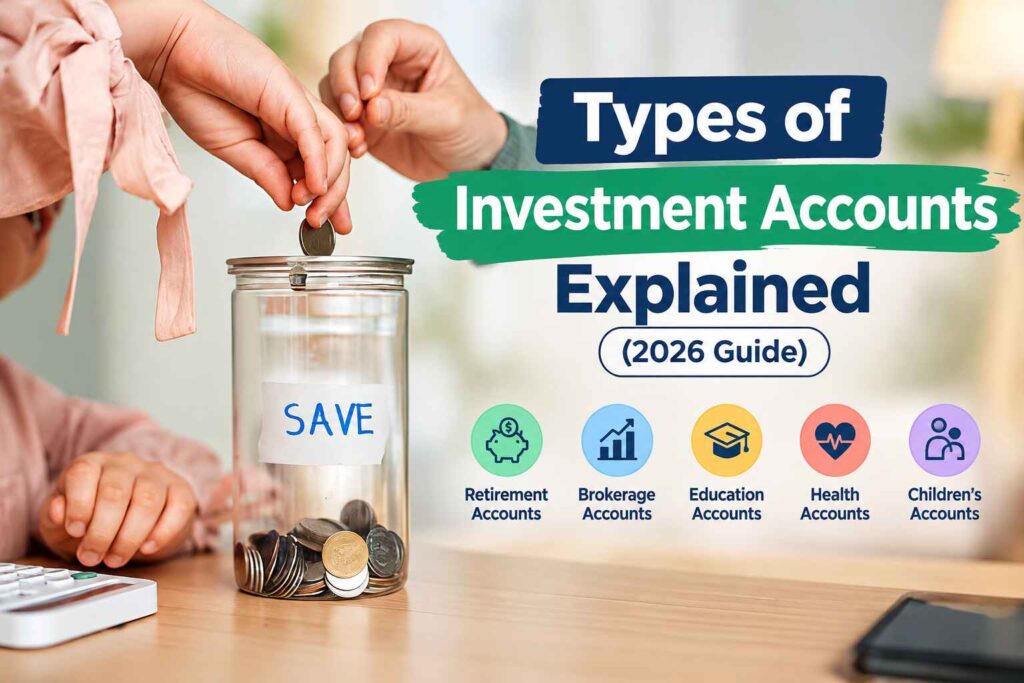
The main types of investment accounts in the U.S. fall into five groups: taxable brokerage accounts for general investing, retirement accounts such as IRAs and 401(k)s, education accounts such as 529 plans, health savings accounts (HSAs), and custodial accounts opened by an adult for a child. On top of that, most brokerage accounts can be run as a cash or margin account, and self-directed or managed by an advisor.
What separates them isn’t what you can buy. You can hold stocks, bonds, ETFs and mutual funds in almost all of them. The differences are five things: what the money is for, how it’s taxed, when you can take it out, who legally owns it, and what investments the provider offers. Get those five clear and choosing between accounts gets much easier.
This guide covers U.S. accounts and U.S. federal tax rules for 2026. Other countries use different account types, and state tax treatment can differ.
Investment account vs investment: what’s the difference?
An investment account is the container. An investment is what you put in it.
A Roth IRA, for example, isn’t an investment by itself. It’s an account type with specific tax rules. If you deposit $3,000 into a Roth IRA and never buy anything, that money sits in cash earning very little. The growth comes from the fund, stock or bond you buy inside the account.
So “Should I buy an ETF or open a Roth IRA?” isn’t an either-or question. A common setup is a Roth IRA that holds an index ETF. The account decides the tax rules; the ETF decides the risk and return.
The main types of investment accounts
Taxable brokerage accounts
A standard brokerage account has no special tax treatment and no purpose restriction. You can deposit any amount, invest in whatever the broker offers, and withdraw whenever you want.
The trade-off is taxes. Dividends and interest are generally taxed in the year you receive them, and selling an investment for more than you paid creates a capital gain. Gains on investments held longer than one year usually get lower long-term capital gains rates than short-term gains.
Brokerage accounts can be individual (one owner) or joint (commonly spouses, with both owning the assets). People often use them for goals that fall before retirement, or for money beyond what they can put into retirement accounts.
Also Read: How to Open an Online Brokerage Account
Retirement accounts
Retirement accounts trade access for tax benefits. The core rule across most of them: take money out before age 59½ and you’ll generally owe income tax plus a 10% additional tax on the taxable portion, unless an exception applies.
Traditional IRA. You open it yourself at a broker. Contributions may be tax-deductible, growth is tax-deferred, and withdrawals are taxed as income. The deduction can shrink or disappear if you or your spouse has a workplace plan and your income is above IRS thresholds.
Roth IRA. You contribute money you’ve already paid tax on. Qualified withdrawals in retirement, including the growth, are tax-free. You can generally take out your original contributions (not earnings) at any time. Eligibility to contribute directly phases out at higher incomes: for 2026 the range is $153,000–$168,000 for single filers and heads of household, and $242,000–$252,000 for married couples filing jointly.
The 2026 IRA limit is shared: annual IRA contributions rose to $7,500 from $7,000, and that limit covers traditional and Roth IRAs combined, not each one separately. People 50 and older can add a $1,100 catch-up, for a total of $8,600.
401(k) and Roth 401(k). Employer-sponsored plans. Contributions come straight from your paycheck, and many employers add matching money. The investment menu is chosen by the plan, usually a short list of funds. For 2026, you can put up to $24,500 into a traditional 401(k), a Roth 401(k), or a mix of the two. Workers 50 and older can generally contribute up to $32,500, and a higher catch-up of $11,250 applies at ages 60–63.
403(b) and 457(b). Similar workplace plans for public school, nonprofit and government employees. Most 403(b) and governmental 457 plans share the same 2026 limits as 401(k)s. 457(b) plans have one notable difference: withdrawals after leaving your employer generally aren’t hit with the 10% early withdrawal tax.
SEP IRA and SIMPLE IRA. Retirement accounts for self-employed people and small businesses. SIMPLE IRA contributions are capped at $17,000 for 2026. SEP IRAs are funded by the employer (which includes you, if you’re self-employed).
Also Read: Retirement Calculator
529 education plans
A 529 plan is designed for education costs. Growth is tax-free at the federal level when withdrawals pay for qualified education expenses, such as college tuition, and in limited amounts K–12 tuition. Many states also give a state tax deduction for contributions.
Use the money for something else and the earnings portion is generally taxed as income plus a 10% additional tax. There’s no federal annual contribution limit, but large gifts can raise gift tax reporting questions, and each state plan sets its own lifetime maximum. Investment choices are limited to the plan’s menu, often age-based portfolios. Under SECURE 2.0, some unused 529 money can roll into a Roth IRA for the beneficiary, subject to conditions including a 15-year account age and a lifetime cap.
Health savings accounts (HSAs)
An HSA is a health account first and an investment account second. You can only contribute if you’re covered by a qualifying high-deductible health plan. For 2026 the limits are $4,400 for self-only coverage and $8,750 for family coverage, and people 55 and older who aren’t on Medicare can add $1,000.
Contributions are pre-tax or deductible, growth isn’t taxed, and withdrawals for qualified medical expenses are tax-free. Not every HSA provider lets you invest the balance. Some keep it in cash until it passes a minimum, and fees vary a lot.
Custodial accounts for children
A custodial account (UTMA or UGMA, depending on the state) lets an adult invest on behalf of a minor. The key point many parents miss: the money legally belongs to the child. Contributions are irrevocable gifts, and the child takes full control at the age set by state law, usually between 18 and 21. There’s no restriction on how they spend it at that point.
A custodial Roth IRA is also possible, but only if the child has earned income, and contributions can’t exceed what they earned that year. By contrast, in a 529 plan the parent usually remains the account owner and can change the beneficiary.
Cash vs margin accounts
This isn’t a separate account type so much as a setting on a brokerage account.
In a cash account, you pay the full price for everything you buy. In a margin account, the broker lends you money using your investments as collateral. You pay interest on the loan, and losses are magnified: if your holdings fall far enough, you’ll face a margin call, meaning you must add money or the broker can sell your investments, sometimes without notice. Retirement accounts generally don’t allow borrowing on margin. Beginners don’t need margin to invest, and most brokers let you choose a cash account.
Self-directed, robo-advisor and advisory accounts
This describes who makes the decisions, not the tax type. Any of the accounts above can be run in one of three ways:
- Self-directed: you pick and trade investments yourself.
- Robo-advisor: software builds and rebalances a portfolio based on a questionnaire, usually for an annual fee charged as a percentage of assets.
- Advisory account: a registered investment adviser manages the money and may offer financial planning, typically for a higher fee.
None is automatically better. The questions are how much help you want and what it costs over time.
Investment account types compared
Figures are 2026 federal limits. State rules and personal circumstances can change the picture.
| Account | Main purpose | Tax treatment | 2026 contribution limit | Access before retirement age | Investment choices |
|---|---|---|---|---|---|
| Taxable brokerage | General investing | Dividends and gains taxed yearly | None | Anytime | Broad (broker’s full menu) |
| Traditional IRA | Retirement | Possible deduction; taxed on withdrawal | $7,500 shared with Roth IRA ($8,600 if 50+) | Tax + usually 10% penalty before 59½ | Broad |
| Roth IRA | Retirement | Taxed now; qualified withdrawals tax-free | Same shared $7,500; income limits apply | Contributions anytime; earnings restricted | Broad |
| 401(k) / 403(b) | Workplace retirement | Pre-tax or Roth | $24,500 ($32,500 if 50+) | Restricted; plan rules vary | Plan’s fund menu |
| 457(b) (governmental) | Government-employee retirement | Pre-tax or Roth | $24,500 ($32,500 if 50+) | No 10% penalty after leaving employer | Plan’s fund menu |
| 529 plan | Education | Tax-free growth for qualified education | No federal annual limit; state lifetime caps | Non-qualified earnings taxed + 10% | Plan’s portfolios |
| HSA | Medical costs | Deductible in, tax-free out for medical | $4,400 self / $8,750 family | Tax-free for medical; penalty otherwise before 65 | Varies by provider |
| Custodial (UTMA/UGMA) | Gift to a child | Taxable; kiddie tax rules may apply | None | Child controls at state age of majority | Broad |
Taxable vs tax-advantaged investment accounts
A taxable account taxes you along the way: on dividends and interest each year, and on gains when you sell. In return, you get full flexibility.
Tax-advantaged accounts give up some flexibility for one or more of three benefits, and they don’t all get the same ones:
- Tax break going in: Traditional IRA, traditional 401(k), HSA
- Tax-deferred or tax-free growth: all of them
- Tax-free withdrawals: Roth accounts in retirement, 529s for education, HSAs for medical costs
The HSA is the only common account with all three, and only when the money is spent on qualified medical costs.
Also Read: QQQ Dividend Calculator
Matching accounts to goals
| If your goal is… | Account types worth researching | Why they may fit |
|---|---|---|
| Money you might need within a few years | Taxable brokerage (or savings, for short timelines) | No withdrawal restrictions |
| Retirement, with a workplace plan | 401(k), 403(b) or 457(b), plus an IRA | Payroll contributions and possible employer match |
| Retirement, no workplace plan or self-employed | Traditional or Roth IRA, SEP or SIMPLE IRA | Individual retirement tax benefits |
| College or school costs | 529 plan | Tax-free growth for qualified education expenses |
| Medical costs, now or later | HSA (if eligible) | Tax-free withdrawals for medical expenses |
| Investing for a child | 529, custodial account, custodial Roth IRA if the child earns income | Differ in ownership and permitted use |
Two quick scenarios show how the dials work. A worker whose employer matches 401(k) contributions would usually look at that plan first, because the match is money they don’t get elsewhere, then at an IRA for a wider fund choice. Someone saving for a house down payment in four years would likely look at a taxable account (or cash savings), since retirement accounts would penalize an early withdrawal.
Can you have more than one investment account?
Yes. There’s no limit on how many accounts you can open, and many people hold several because each does a different job, such as a 401(k) at work, a Roth IRA, a taxable brokerage account and a 529 for a child.
What’s limited is how much you can contribute to each account type per year. Opening a second Roth IRA doesn’t give you a second $7,500; the limit applies across all your IRAs. Workplace plan deferral limits likewise apply per person across all 401(k) and 403(b) plans, even if you have two jobs.
If you change jobs, your old 401(k) doesn’t disappear. You can usually leave it, roll it into the new employer’s plan, or roll it into an IRA.
How to compare investment accounts
Before opening any account, run through these questions:
- What is the money for, and when will you need it?
- Do you need access before retirement? If yes, a retirement account may be the wrong container for that money.
- Is there an employer match or other employer contribution you’d miss by not using a workplace plan?
- Are you eligible? Roth IRAs have income limits, HSAs require a qualifying health plan, custodial Roth IRAs require earned income.
- Who will own the money? This matters most with accounts for children.
- What can you invest in? Brokerage accounts and IRAs offer wide choice; 401(k)s, 529s and some HSAs offer a set menu.
- What are the total costs? Look at fund expense ratios, advisory or robo fees, account fees, transfer fees and margin interest. “Commission-free trading” doesn’t mean the funds you buy are free to own.
- What happens to taxes when you withdraw?
Risks and limits to keep in mind
Account type doesn’t protect you from market losses. A Roth IRA full of volatile stocks can drop just as much as a taxable account holding the same stocks. Tax benefits come with conditions, and missing them (withdrawing early, over-contributing, spending HSA or 529 money on non-qualified costs) can cost you in taxes and penalties. Contribution limits and income thresholds change most years, and tax law itself can change.
Frequently Asked Questions
-
What are the main types of investment accounts?
Taxable brokerage accounts, retirement accounts (IRAs and workplace plans such as 401(k)s), 529 education plans, HSAs and custodial accounts for children. -
What's the difference between a brokerage account and an IRA?
Both can hold the same investments. A brokerage account has no contribution limit and no withdrawal restrictions but is taxed each year. An IRA has an annual limit and early withdrawal rules, in exchange for tax-deferred or tax-free growth. -
Can you buy stocks inside an IRA?
Yes. Most IRAs at brokers let you buy individual stocks, ETFs, mutual funds and bonds. -
Are investment accounts taxable?
Taxable brokerage and custodial accounts are. Retirement accounts, 529s and HSAs are tax-advantaged, but withdrawals can still be taxed depending on the account and how the money is used. -
What's the difference between a cash and a margin account?
In a cash account, you pay in full for purchases. A margin account lets you borrow from the broker against your holdings, which adds interest costs and can amplify losses. -
What investment accounts are available for children?
529 plans, UTMA/UGMA custodial accounts, and custodial Roth IRAs if the child has earned income. They differ mainly in who controls the money and what it can be spent on. -
Can I contribute to a 401(k) and an IRA in the same year?
Yes, the limits are separate. Having a workplace plan can reduce your traditional IRA deduction, depending on income. -
What happens to my 401(k) if I leave my job?
It stays yours. You can usually leave it in the old plan, move it to your new employer's plan, or roll it into an IRA.
This article is for general education and isn’t personal financial, tax or legal advice. Limits shown are for tax year 2026. Check IRS.gov or speak with a qualified professional about your situation.
Sources:
Figures in this guide are for tax year 2026 and come from these primary sources:
- Internal Revenue Service (IRS), November 2025: 401(k) limit increases to $24,500 for 2026, IRA limit increases to $7,500. The release sets the 2026 IRA limit at $7,500 (up from $7,000), the 401(k), 403(b) and governmental 457 deferral limit at $24,500, the age-50 catch-up at $8,000, and the age 60–63 catch-up at $11,250.
- IRS Notice 2025-67: 2026 Amounts Relating to Retirement Plans and IRAs. The official notice behind the 2026 retirement limits, including the $17,000 SIMPLE IRA limit.
- IRS Revenue Procedure 2025-19 and IRS Publication 969: Set the 2026 HSA limits at $4,400 for self-only coverage and $8,750 for family coverage, plus a $1,000 catch-up at age 55.
- U.S. Securities and Exchange Commission (SEC), Investor.gov: Types of Investment Accounts (confirm the direct page URL). Defines brokerage, advisory and tax-advantaged accounts, and confirms an investor can hold more than one account type.
- Financial Industry Regulatory Authority (FINRA): Margin accounts guidance (confirm the direct page URL). Explains margin borrowing, interest costs and margin calls.


