Someone tells you to “park your cash in the money market” while someone else says you should be “investing in the capital market.” Are these two different names for the same thing? Not even close, and the confusion around capital market vs money market is one of the most common mix-ups new investors run into.
Here’s the short version: the money market handles short-term borrowing and lending, usually for less than a year, using low-risk instruments like Treasury bills. The capital market handles long-term investment, usually for more than a year, using instruments like stocks and bonds that carry higher risk and higher potential reward.
They’re not competitors. They’re two different tools built for two different jobs. This guide breaks down exactly how they differ, when to use each one, and where beginners most commonly get confused.
Key Takeaways
- The money market deals in short-term debt (under 1 year); the capital market deals in long-term securities (over 1 year).
- Money market instruments are generally lower risk and lower return; capital market instruments generally carry higher risk and higher potential return.
- The capital market includes both equity (stocks) and debt (bonds); the money market is debt-only.
- Most financial plans use both: money market for short-term safety and liquidity, capital market for long-term growth.
What Is the Capital Market?
The capital market is where companies, governments, and institutions raise long-term funding by issuing securities like stocks and bonds, and where investors buy and trade those securities afterward. “Long-term” here typically means the security has a maturity of more than one year, or in the case of stocks, no fixed maturity at all.
Common capital market instruments:
- Stocks (equity shares)
- Corporate bonds
- Government bonds (long-term)
- Municipal bonds
- Mutual funds
- ETFs
- REITs
- Debentures
The capital market exists to fund things that take years to pay off: factories, infrastructure, long-term business expansion, and government projects like highways or hospitals.
What Is the Money Market?
The money market is where short-term borrowing and lending happens, using debt instruments that mature in one year or less. It exists to help governments, banks, and corporations manage short-term cash needs, like meeting payroll, covering short-term operating costs, or managing temporary funding gaps.
Common money market instruments:
- Treasury bills (T-bills)
- Commercial paper
- Certificates of deposit (CDs)
- Repurchase agreements (repos)
- Banker’s acceptances
- Short-term municipal notes
Unlike the capital market, the money market deals exclusively in debt. There is no equity (stock ownership) component here at all. Before going further into capital market vs money market specifics, it helps to keep this one distinction in mind: ownership versus lending.
Capital Market vs Money Market: Full Comparison
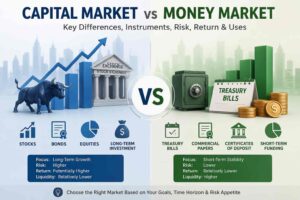
| Factor | Capital Market | Money Market |
|---|---|---|
| Definition | Market for long-term securities used to raise long-term capital | Market for short-term debt instruments used to manage short-term liquidity |
| Investment period | More than 1 year (stocks have no fixed maturity) | 1 year or less, often just days to months |
| Purpose | Long-term capital formation and wealth growth | Short-term cash management and liquidity |
| Instruments | Stocks, bonds, mutual funds, ETFs, REITs, debentures | T-bills, commercial paper, CDs, repos, banker’s acceptances |
| Includes equity? | Yes (stocks represent ownership) | No (debt instruments only) |
| Risk level | Generally moderate to high | Generally low |
| Return potential | Generally higher over the long term | Generally lower, closer to short-term interest rates |
| Liquidity | High for listed stocks; varies for bonds | Very high; among the most liquid instruments in finance |
| Regulation | SEC, FCA, ASIC, SECP, and equivalent national securities regulators | Central banks and securities regulators jointly, depending on instrument |
| Typical participants | Retail investors, institutional investors, corporations, governments | Banks, corporations, governments, money market funds |
| Volatility | Can be significant, especially for stocks | Minimal, prices move very little |
| Example | Buying shares of a company or a 10-year government bond | Buying a 91-day Treasury bill or a bank certificate of deposit |
Risk and Return: Why the Gap Exists
The risk and return difference between these two markets isn’t random. It comes directly from time horizon and instrument type.
Money market instruments are short-term and typically backed by extremely creditworthy borrowers (governments, major banks, blue-chip corporations), which is exactly why their returns stay modest. You’re lending money for a few weeks or months to a borrower unlikely to default in that window, so the compensation you receive reflects that low risk.
Capital market instruments, particularly stocks, involve real business risk over a much longer horizon. A company might grow significantly, or it might struggle. That uncertainty is precisely why capital market investments carry the potential for meaningfully higher long-term returns than the guaranteed, modest yield of a money market instrument.
| Return Driver | Money Market | Capital Market |
|---|---|---|
| Main return source | Interest based on prevailing short-term rates | Capital appreciation (price growth) and dividends/interest |
| Return predictability | High; return is generally known upfront | Low; return is unknown until the investment matures or is sold |
| Return ceiling | Capped, tied closely to short-term interest rate levels | Uncapped for stocks; long-term historical averages have outpaced money market returns |
| Return floor | Rarely negative for held-to-maturity instruments | Can be significantly negative, especially over short periods |
Liquidity: Which One Gets You Cash Faster?
Liquidity means how quickly and easily you can convert an investment into usable cash without losing significant value.
- Money market instruments are built for liquidity. Many can be converted to cash within days, and some money market funds allow same-day or next-day access, which is exactly why they’re commonly used as a parking spot for emergency funds or short-term savings goals.
- Capital market instruments vary. Publicly listed stocks are highly liquid, often convertible to cash within a day or two through a regulated exchange. Bonds can be less liquid depending on the issuer and how actively that specific bond trades. Some capital market instruments, particularly less commonly traded corporate bonds, can take longer to sell without accepting a lower price.
Who Participates in Each Market
| Participant | Role in Capital Market | Role in Money Market |
|---|---|---|
| Individual/retail investors | Buy stocks, bonds, mutual funds, ETFs for long-term growth | Buy money market funds or CDs for short-term savings |
| Commercial banks | Underwrite and trade securities, offer brokerage services | Major borrowers and lenders of short-term funds |
| Corporations | Raise long-term funding through stock and bond issuance | Manage short-term cash needs through commercial paper |
| Governments | Issue long-term bonds to fund infrastructure and public projects | Issue Treasury bills to manage short-term budget needs |
| Institutional investors (pension funds, insurers) | Hold large long-term equity and bond positions | Hold money market instruments for liquidity management |
| Central banks | Limited direct role; influence market conditions through policy | Actively manage short-term interest rates and liquidity |
Regulation: Who Oversees What
Both markets are regulated, but the emphasis differs.
- Capital market regulation focuses heavily on disclosure, fraud prevention, and fair trading practices for long-term securities. In the US, this falls primarily under the SEC and FINRA. In the UK, the FCA oversees this role. In Australia, it’s ASIC, and in Pakistan, the SECP and PSX regulate this space.
- Money market regulation often involves central banks more directly, since money market activity is closely tied to monetary policy and short-term interest rate management, alongside standard securities regulators overseeing money market funds and instruments sold to the public.
Real-World Example: The Same Company, Two Different Markets
Consider a mid-sized manufacturing company that needs funding for two very different reasons:
Scenario 1: Building a new factory. This is a multi-year project requiring a large amount of long-term capital. The company issues a 10-year corporate bond in the capital market, raising the funds it needs while committing to pay interest over the full decade.
Scenario 2: Covering next month’s payroll during a temporary cash flow gap. This is a short-term need. Instead of touching its long-term capital, the company issues commercial paper in the money market, borrowing for 30 to 90 days from institutional investors and repaying it quickly once incoming revenue arrives.
Same company, two completely different financial tools, chosen specifically because of the timeframe and purpose behind each need. This is exactly how individual investors should think about the two markets as well.
5 Key Differences Between Money Market and Capital Market
1. Investment Period
The money market deals in short-term instruments maturing in one year or less. The capital market deals in long-term securities, typically maturing in more than one year, with stocks having no fixed maturity at all.
2. Instruments Involved
The money market includes only debt instruments like Treasury bills, commercial paper, and certificates of deposit. The capital market includes both debt (bonds) and equity (stocks), along with mutual funds, ETFs, and REITs.
3. Risk Level
Money market instruments are backed by highly creditworthy borrowers over short timeframes, making them low risk. Capital market instruments, especially stocks, carry moderate to high risk due to longer time horizons and real business uncertainty.
4. Return Potential
Money market returns stay close to prevailing short-term interest rates and are generally modest but predictable. Capital market returns are less predictable in the short term but have historically offered significantly higher growth potential over the long term.
5. Purpose
The money market exists to manage short-term liquidity, like a company covering payroll or an investor parking an emergency fund. The capital market exists to raise and grow long-term capital, like funding a new factory or building long-term personal wealth.
Pros and Cons of the Capital Market
| Pros | Cons |
|---|---|
| Higher long-term return potential | Higher volatility, especially with equities |
| Ownership stake in real businesses (stocks) | Requires more research and monitoring |
| Wide variety of instruments for different goals | Can involve significant short-term losses |
| Historically outpaces inflation over long periods | Less predictable returns |
Pros and Cons of the Money Market
| Pros | Cons |
|---|---|
| Very low risk and high stability | Returns often barely keep pace with inflation |
| High liquidity, easy access to cash | Limited long-term wealth-building potential |
| Predictable, known returns | Not suitable as a primary long-term growth strategy |
| Ideal for short-term goals and emergency funds | Minimum investment amounts can be high for some instruments (like direct T-bills) |
Common Misconceptions Beginners Have
- “Money market account” and “money market instrument” are the same thing. They’re related but different. A money market account is a type of bank deposit account offering modest interest and easy access, while a money market instrument (like a T-bill or commercial paper) is a specific tradable security. A money market fund is yet another related but distinct product, a mutual fund that invests in money market instruments.
- “The money market is completely risk-free.” It’s low risk, not zero risk. Money market funds are not FDIC-insured in the US (unlike a bank savings account), and while defaults are rare, they’re not impossible.
- “Capital market just means the stock market.” The stock market is only one part of the capital market. Bonds, mutual funds, ETFs, and REITs are all part of the capital market too.
- “You should pick one market and stick with it.” Most well-structured financial plans use both, money market for short-term safety and liquidity, capital market for long-term growth, not one instead of the other.
So, Which One Is Better?
When people frame capital market vs money market as a competition, they’re asking the wrong question. It’s like asking whether a hammer is better than a screwdriver. It depends entirely on the job.
- Choose the money market when: you need the money within the next 1 to 12 months, you’re building an emergency fund, or capital preservation matters more to you than growth.
- Choose the capital market when: you’re investing for a goal more than a year away, ideally 5 to 10+ years out, and you can tolerate short-term price swings in exchange for higher long-term growth potential.
Most financial professionals recommend using both together: money market instruments for your emergency fund and short-term goals, capital market instruments for retirement and long-term wealth building.
Expert Tips
- Never invest your emergency fund in the capital market. Its short-term volatility makes it a poor match for money you might need on short notice.
- Don’t let idle cash sit doing nothing. If you have a cash cushion beyond your emergency fund sitting in a low-interest checking account, a money market fund or CD typically offers a meaningfully better return with minimal added risk.
- Match the instrument to the timeline, not the hype. A financial goal 18 months away belongs in the money market. A goal 15 years away belongs primarily in the capital market.
- Revisit the split as your goals change. As a specific goal gets closer (like a house purchase within a year), it’s common practice to shift funds earmarked for that goal from capital market investments into money market instruments to protect against a badly timed downturn.
Frequently Asked Questions
What is the main difference between the capital market and the money market?
The capital market deals in long-term securities like stocks and bonds, typically maturing in more than a year, while the money market deals in short-term debt instruments like Treasury bills, typically maturing in a year or less. Capital markets carry more risk and higher potential return; money markets prioritize safety and liquidity.
Which is safer, the capital market or the money market?
The money market is generally considered safer due to its short maturities and typically high-credit-quality borrowers, though “safer” doesn’t mean risk-free. The capital market carries more volatility, particularly in equities, but has historically offered higher returns over long periods.
Can individuals invest directly in the money market?
Yes. Individuals can buy Treasury bills directly through government platforms in many countries, invest in money market mutual funds through a brokerage, or open a money market account through a bank.
Is a money market fund the same as a money market account?
No. A money market fund is a mutual fund investing in short-term debt instruments, typically offered through a brokerage and not government-insured. A money market account is a bank deposit product, usually offering deposit insurance up to a certain limit, along with limited check-writing or debit access.
What is an example of a capital market instrument?
Common examples include company shares (stocks), corporate and government bonds with maturities over a year, mutual funds, ETFs, and REITs.
What is an example of a money market instrument?
Common examples include Treasury bills, commercial paper, certificates of deposit, repurchase agreements, and banker’s acceptances, all typically maturing within a year.
Do money market investments pay interest or dividends?
Money market instruments generally pay interest, reflecting their nature as short-term debt. Dividends are specific to equity investments like stocks, which belong to the capital market, not the money market.
Why do companies use the money market instead of the capital market for short-term needs?
Raising long-term capital through the capital market for a short-term need, like a temporary payroll gap, would be inefficient and often more expensive. The money market offers faster, more cost-effective short-term borrowing specifically designed for that purpose.
Should beginners invest in the capital market or the money market first?
Most financial guidance suggests building an emergency fund in money market instruments or a high-yield savings option first, then directing additional savings toward the capital market for long-term growth once that safety net is in place.
How does inflation affect each market differently?
Money market returns often struggle to outpace inflation over time, since they’re tied closely to short-term interest rates. Capital market investments, particularly stocks, have historically offered better long-term protection against inflation, though with more short-term volatility along the way.
Are money market and capital market instruments taxed differently?
Interest income from most money market instruments is typically taxed as ordinary income. Capital market returns can be taxed differently depending on the instrument and holding period, for example, long-term capital gains on stocks often receive more favorable tax treatment than short-term gains or interest income, though rules vary significantly by country.
Key Takeaways
- The money market handles short-term debt (under 1 year); the capital market handles long-term securities (stocks and bonds, generally over 1 year).
- Money market instruments prioritize safety and liquidity; capital market instruments prioritize long-term growth potential.
- The capital market includes both equity and debt; the money market is debt-only.
- A well-rounded financial plan typically uses both markets for different purposes, not one exclusively.
- Match the instrument to your timeline: short-term goals belong in the money market, long-term goals belong primarily in the capital market.
Conclusion
Capital market and Money market isn’t really a rivalry once you understand what each one is built for. They’re two different tools solving two different problems: one built for safety and short-term liquidity, the other built for long-term growth. Understanding which one fits a specific financial goal, rather than treating “investing” as one single decision, is what separates a genuinely well-structured financial plan from a random collection of accounts.
Build your emergency fund and short-term savings in money market instruments. Direct your long-term goals, retirement, wealth building, major future purchases, toward the capital market. Used together, deliberately, they cover both what you need next month and what you’re building over the next several decades.
Disclaimer: This article is for educational purposes only and does not constitute financial advice. Investment returns are not guaranteed, and all investments carry risk, including potential loss of principal. Always conduct your own research and consult a qualified financial adviser before making investment decisions.


