A stock priced at 40 cents feels different from a stock priced at 400 dollars. With 500 dollars, you can only buy one share of a company like Netflix, but you could buy 1,250 shares of a penny stock. That math is exactly why penny stocks pull in so many new investors. The idea of owning thousands of shares, and the fantasy of one of them turning into “the next big thing,” is genuinely exciting.
Here’s what usually doesn’t make it into the pitch: most penny stocks lose money for the people who buy them, and a meaningful number of them are connected to outright fraud. That doesn’t mean every penny stock is a scam or that nobody ever makes money on one. It means the odds are stacked differently than they are with established companies, and almost nobody explains exactly how before a beginner buys their first share.
This guide walks through what penny stocks actually are, why they’re so appealing, what tends to go wrong, how to evaluate one if you’re determined to try, and the red flags that separate a legitimate small company from a scam waiting to happen. By the end, you’ll have a realistic picture instead of a hyped-up one.
What Are Penny Stocks?
The U.S. Securities and Exchange Commission formally defines a penny stock, under Rule 15g-9, as an equity security priced under five dollars per share that generally isn’t listed on a major national exchange such as the NYSE or Nasdaq. In everyday use, though, the term gets applied more loosely. Financial media and investors often call any very low-priced, small-cap stock a “penny stock,” even when it technically trades on a major exchange.
A few defining traits show up again and again:
- Price: typically under five dollars, and often well under one dollar
- Market capitalization: usually classified as micro-cap or nano-cap, meaning the entire company might be worth a few million dollars rather than billions
- Trading venue: many penny stocks trade over-the-counter (OTC) rather than on a major exchange, through networks like OTC Markets Group
- Liquidity: low trading volume, which means it can be hard to buy or sell shares at the price you expect
- Volatility: prices can swing 20, 50, or even 100 percent in a single session on relatively small amounts of trading
Not every penny stock is a shady shell company. Some are legitimate early-stage businesses that simply haven’t grown large enough, or built enough of a track record, to list on a major exchange yet. The challenge for a beginner is telling the two apart.
Why Beginners Are Attracted to Penny Stocks
The appeal is easy to understand, and it’s worth naming honestly rather than dismissing it.
Low share prices make penny stocks feel accessible. A beginner with a few hundred dollars can buy a large number of shares, which feels more substantial than owning a fraction of a share in a bigger company.
The potential for outsized returns is real, at least in theory. A stock that moves from ten cents to fifty cents has “only” gained forty cents, but that’s a 400 percent return. Stories about people who caught a move like that spread fast, especially on social media.
Social media and forum hype now play an outsized role. Stock-focused communities on platforms like Reddit, X, and TikTok can turn an obscure ticker into a trending topic within hours, creating a sense of momentum that pulls in new buyers.
Fear of missing out (FOMO) does the rest. When a stock is already up 30 percent for the day and people are posting screenshots of their gains, it can feel like the only mistake is not buying in.
Accessibility matters too. Most brokerage apps let you buy penny stocks with a few taps, no special account or paperwork required for the trade itself (though, as you’ll see below, your broker may still need to sign off on your account for penny stock trading).
None of these reasons are irrational. They’re just incomplete, because they leave out the risks that make penny stocks a fundamentally different kind of investment.
What Nobody Tells You Before Buying Penny Stocks
This is the part that rarely makes it into the hype.
Most penny stocks fail. The vast majority of companies trading as penny stocks never grow into profitable, stable businesses. Many are burning through cash with no clear path to revenue, and a large share eventually go to zero or get delisted entirely.
Liquidity can disappear overnight. A stock might trade a few thousand shares a day. If you own a large position and try to sell, you may not find enough buyers at your target price, forcing you to accept a much lower one just to exit.
Price manipulation is common, not rare. Because trading volume is thin and public information is limited, it doesn’t take much money to move a penny stock’s price. That makes these stocks attractive targets for people who want to manipulate prices rather than build companies.
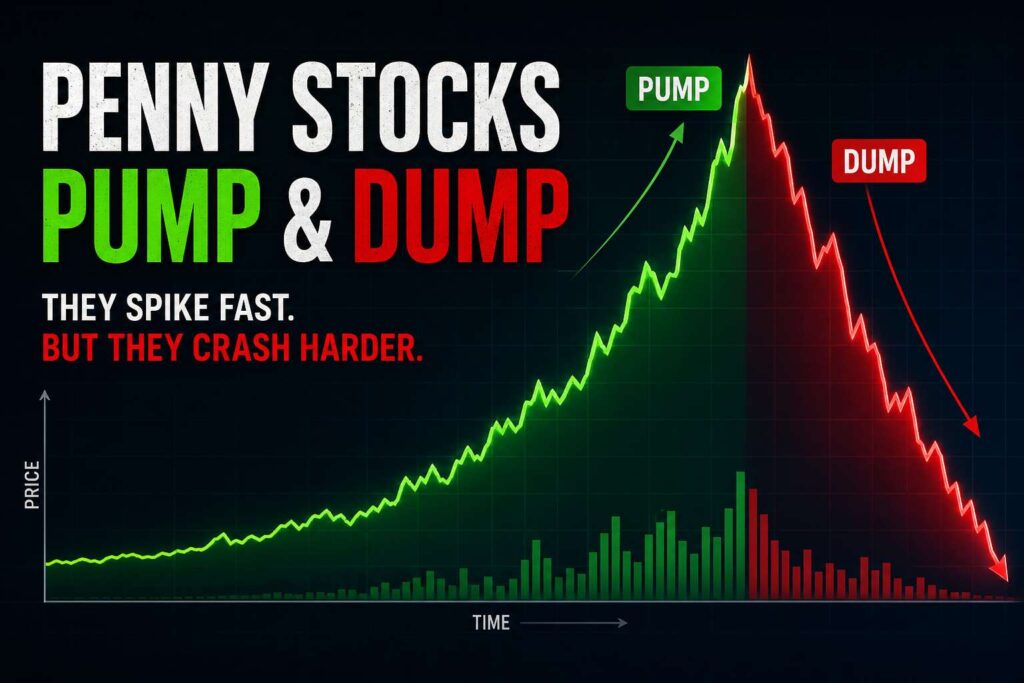
Pump-and-dump schemes follow a predictable pattern. Promoters quietly accumulate shares in a thinly traded stock, then aggressively hype it through newsletters, social media posts, or “can’t miss” press releases. As buying pressure builds and the price rises, the promoters sell into the rally. Once they’ve exited, the price collapses, often leaving the remaining shareholders holding stock that’s worth a fraction of what they paid, or nothing at all.
Fake newsletters and paid promotions are everywhere. Some “stock alert” newsletters are paid by the company itself, or by shareholders looking to exit, to promote a stock as an unmissable opportunity. This is technically legal if disclosed, but the disclosures are often buried in fine print that most readers skip.
Social media influencers aren’t always neutral. Some accounts promoting a stock have already bought in at a much lower price and are trying to create buying pressure that lets them sell at a profit.
Financial transparency is often limited. Companies trading on the lowest tiers of the OTC market aren’t required to file the same level of financial disclosure as companies on major exchanges. Some don’t file with the SEC at all.
Analyst coverage is close to nonexistent. Wall Street analysts rarely cover companies this small, which means you won’t find the research reports, earnings estimates, or price targets that exist for larger stocks. You’re mostly on your own.
Emotional trading gets amplified. The combination of fast price swings and small account sizes makes it easy to chase momentum, panic-sell on a dip, or double down on a losing position hoping for a rebound.
Selling can be harder than buying. In a thinly traded stock, the gap between the price buyers are willing to pay and the price sellers are asking (the bid-ask spread) can be large, quietly eating into your returns even if the stock price looks unchanged.
Reverse stock splits are a warning sign, not a fresh start. When a struggling company’s share price drops too low to meet exchange listing requirements, it may do a reverse split, for example turning every 50 shares into 1. This raises the per-share price without changing the value of your holdings, and FINRA has specifically cautioned investors that reverse splits often precede continued price declines rather than a turnaround. Reverse splits at penny stock companies have become noticeably more frequent over the past few years.
Delisting risk is real. Stocks that fall out of compliance with exchange rules, whether due to price, market value, or reporting failures, can be delisted and pushed down into the OTC market, where liquidity and information are both weaker.
Advantages of Penny Stocks
To be fair, there are reasons this corner of the market attracts attention beyond pure hype.
- Low capital requirement, which lets beginners practice buying, selling, and tracking a position without risking a large amount of money
- High growth potential, since a small company that genuinely succeeds can deliver returns that a mega-cap stock simply can’t match percentage-wise
- Diversification by share count, meaning you can spread a small amount of money across several positions and own more individual companies than you could with the same budget in higher-priced stocks
- A learning environment, where the fast price action forces you to pay attention to order types, position sizing, and risk management earlier than you might with a slower-moving blue-chip portfolio
These benefits are real, but they come with a large asterisk: the same features that make penny stocks appealing (low price, small size, thin coverage) are also what make them risky.
Disadvantages and Risks
The risk list is longer than the reward list, and it deserves to be laid out plainly.
- High failure rate. Most micro-cap companies never become profitable, sustainable businesses.
- Extreme volatility. Sharp swings in both directions can wipe out a position quickly.
- Poor liquidity. Getting in is often easier than getting out at a fair price.
- Manipulation exposure. Pump-and-dump schemes and coordinated hype campaigns disproportionately target this segment.
- Limited public information. Weaker disclosure requirements mean you’re often investing with an incomplete picture of the business.
- Dilution risk. Struggling small companies frequently raise cash by issuing new shares, which reduces the value of shares already outstanding.
- Wide bid-ask spreads. These quietly reduce your realized returns even on winning trades.
- Emotional strain. Fast, unpredictable price action can push even disciplined investors into impulsive decisions.
Common Beginner Mistakes
Most losses in this space trace back to a handful of repeatable mistakes:
- Investing without research, buying purely because a ticker is trending
- Chasing hype, jumping in after a stock has already spiked instead of before
- Buying because it’s “cheap”, confusing a low share price with good value
- Ignoring company fundamentals, skipping revenue, cash flow, and debt entirely
- Over-investing, putting a large share of savings into a single volatile position
- Not using stop-loss orders or a predefined exit plan, letting losses run further than intended
- Emotional decision-making, holding a losing position out of hope rather than analysis
- Lack of diversification, treating one “hot tip” as a substitute for a real investment plan
Recognizing these patterns in yourself before you trade is one of the most useful things a beginner can do.
Also read: Top 10 Best Stocks for Beginners with Little Money
How to Evaluate a Penny Stock
If you’re going to research a penny stock seriously, here’s what to actually look at:
- Revenue and revenue trend. Is the company generating sales, and is that number growing or shrinking over time?
- Earnings and cash flow. Many penny stock companies operate at a loss. Check how much cash they’re burning and how long that cash can last.
- Debt levels. High debt relative to the size of the company can signal financial distress.
- Management background. Search the names of executives and board members. Prior involvement in failed or fraud-linked companies is a serious warning sign.
- SEC filings. Use the SEC’s EDGAR database to check whether the company files regularly, and how recently. A company that’s been dormant and suddenly “comes back to life” with a hot new story deserves extra scrutiny.
- Trading volume. Very low average daily volume means you may struggle to sell without moving the price against yourself.
- News catalysts. Understand whether recent price movement is tied to a verifiable business development or just unverified promotion.
- Industry trends. Even a mediocre company can look interesting during a hot sector cycle. Separate the sector’s momentum from the specific company’s fundamentals.
- Which OTC tier it trades on. OTC Markets Group organizes over-the-counter stocks into tiers. OTCQX sits at the top, for more established companies with stronger disclosure. OTCQB is the venture tier for early-stage but currently reporting companies. The bottom tier (formerly known as Pink Sheets, now largely reorganized under OTCID) has the weakest disclosure requirements and includes shell companies and businesses in financial distress. Knowing which tier a stock trades on tells you a lot about how much scrutiny it’s already had.
Red Flags to Avoid
Regulators including the SEC and FINRA have published warnings about the recurring patterns behind penny stock fraud. Watch for:
- Unsolicited spam emails or text messages promoting a stock
- Promises of “guaranteed” returns or “can’t miss” opportunities
- A previously dormant or inactive company suddenly generating buzz around a new product or industry trend
- Extremely low or suspiciously spiking trading volume
- Frequent reverse stock splits, especially large ones
- Press releases full of vague, unverifiable claims with no independent confirmation
- Little to no financial reporting, or filings that are consistently late
- Shell companies with no real operations, revenue, or assets
If you notice more than one of these at once, treat it as a serious warning rather than a coincidence.
Risk Management Tips
If you choose to invest in penny stocks despite the risks, manage that decision deliberately:
- Position sizing: only allocate money you can genuinely afford to lose, and keep individual positions small relative to your total portfolio
- Diversification: don’t concentrate your capital in one stock or even one sector
- Stop-loss strategies: decide your exit point before you buy, not after the price has already dropped
- Profit-taking discipline: consider locking in gains on the way up rather than assuming a rally will continue indefinitely
- Long-term thinking: for most of your investing capital, established companies with real earnings and analyst coverage remain a more reliable foundation
- Capital preservation: treat penny stock investing as a small, speculative portion of your overall strategy, not the core of it
Step-by-Step Guide to Buying Penny Stocks
- Choose a broker. Look for one that supports OTC trading, since not every brokerage offers full access to every OTC tier, and check what extra requirements or fees apply to penny stock trades.
- Open an account. Standard brokerage account opening applies, but be aware that some brokers require additional acknowledgment or a written agreement before you can trade lower-priced securities, per SEC penny stock sales practice rules.
- Fund the account. Transfer only the amount you’ve decided to allocate to this speculative portion of your portfolio.
- Research the stock. Work through the evaluation criteria above before placing any order.
- Place an order. Consider using a limit order rather than a market order, since penny stocks can have wide bid-ask spreads that make market orders unpredictable.
- Monitor your investment. Check filings, news, and volume regularly rather than assuming a “buy and forget” approach will work here.
- Know when to exit. Have a predefined plan for both taking profits and cutting losses, and stick to it even when emotions say otherwise.
Penny Stocks vs Blue-Chip Stocks
| Factor | Penny Stocks | Blue-Chip Stocks |
|---|---|---|
| Typical price | Under $5, often under $1 | Often $50 and up |
| Market cap | Micro-cap or nano-cap | Large-cap or mega-cap |
| Volatility | Very high | Moderate to low |
| Liquidity | Often thin | Generally strong |
| Financial disclosure | Frequently limited | Extensive, regularly audited |
| Analyst coverage | Rare | Common |
| Historical stability | Low | High |
| Suitable for | Small, speculative allocations only | Core long-term holdings |
Are Penny Stocks Worth It for Beginners?
The honest answer is: for most beginners, penny stocks make more sense as a small, clearly-labeled speculative bucket than as a core investing strategy. The regulatory protections around penny stocks exist precisely because so many investors have been harmed by manipulation, poor disclosure, and unrealistic promotion in this space.
That doesn’t mean nobody should ever touch them. Some experienced investors do take calculated positions in micro-cap companies as part of a diversified approach, using strict position sizing and real due diligence. For a true beginner still building foundational knowledge of how markets work, though, it’s usually smarter to build a base of understanding with more established, better-covered companies first, and treat penny stocks (if at all) as a small, separate experiment rather than where your early capital is concentrated.
Myth vs Fact
Myth: A low share price means the stock is cheap or undervalued. Fact: Share price alone says nothing about value. A $0.50 stock with a bloated share count can be more “expensive” relative to the business than a $500 stock with far fewer shares outstanding.
Myth: If a stock is rising fast, it’s a good sign to buy in. Fact: Rapid, unexplained price spikes in thinly traded stocks are a classic signature of pump-and-dump activity, not necessarily good news.
Myth: Every penny stock is a scam. Fact: Some are legitimate early-stage businesses. The problem is that scams and legitimate companies can look similar on the surface, which is exactly why research matters.
Myth: You can always sell whenever you want. Fact: Low liquidity means you might not find a buyer at your desired price, especially during a downturn.
Checklist Before Buying a Penny Stock
- [ ] I’ve checked the company’s SEC filings and confirmed they’re current
- [ ] I understand the company’s revenue, cash position, and debt
- [ ] I’ve looked into management’s background
- [ ] I know which OTC tier the stock trades on
- [ ] I’ve checked average daily trading volume
- [ ] I’m not buying based solely on social media hype or a paid newsletter
- [ ] I have a predefined exit plan for both gains and losses
- [ ] This position is a small percentage of my total portfolio
- [ ] I’m only using money I can afford to lose
Key Takeaways
- Penny stocks are typically priced under $5 per share and often trade over-the-counter rather than on major exchanges.
- The SEC and FINRA impose extra rules on penny stock sales because manipulation and fraud are disproportionately common in this space.
- Pump-and-dump schemes follow a predictable pattern: quiet accumulation, aggressive promotion, then a sell-off that leaves late buyers with losses.
- Liquidity, financial disclosure, and analyst coverage are all weaker for penny stocks than for established companies.
- Reverse stock splits and dormant companies suddenly generating hype are red flags worth taking seriously.
- Real due diligence, position sizing, and a predefined exit plan matter more here than in almost any other segment of the market.
- For most beginners, penny stocks are better treated as a small, deliberate experiment than a core strategy.
Frequently Asked Questions
Are penny stocks a good investment for beginners?
They can be part of a portfolio, but most financial educators recommend beginners build a foundation with established, well-covered companies first and treat penny stocks as a small, separate, high-risk allocation if they choose to include them at all.
What is considered a penny stock?
The SEC generally defines a penny stock as an equity security priced under $5 per share that isn’t listed on a major national exchange, though the term is often used more loosely for any very low-priced, small-cap stock.
Can you get rich from penny stocks?
It’s possible in theory, since percentage gains can be large on a low-priced stock, but the far more common outcome is a loss, since most micro-cap companies never become profitable, stable businesses.
Why are penny stocks so risky?
Thin trading volume, limited financial disclosure, weak analyst coverage, and a history of price manipulation combine to make penny stocks far more volatile and unpredictable than established stocks.
How do I know if a penny stock is a scam?
Watch for unsolicited promotion, guaranteed-return claims, dormant companies suddenly generating hype, extremely low trading volume, and vague or unverifiable press releases. Cross-check the company’s SEC filings before trusting any of it.
What’s the difference between OTC stocks and penny stocks?
Most penny stocks trade over-the-counter (OTC), but not every OTC stock is a penny stock. OTC simply refers to the trading venue, while “penny stock” typically refers to the low share price and small company size.
Do penny stocks pay dividends?
Rarely. Most penny stock companies are early-stage or financially strained and reinvest any available cash into operations rather than paying shareholders.
What is a pump-and-dump scheme?
It’s a manipulation tactic where promoters accumulate shares in a thinly traded stock, hype it aggressively to attract buyers, then sell their own shares once the price rises, leaving later buyers with losses as the price collapses.
Should I use stop-loss orders for penny stocks?
Many experienced traders do, though wide bid-ask spreads and thin volume can sometimes trigger stop-losses at worse prices than expected. A predefined exit plan, even without an automated stop, is essential either way.
What percentage of my portfolio should go into penny stocks?
There’s no universal number, but many financial educators suggest limiting highly speculative positions like penny stocks to a small single-digit percentage of a total portfolio, reserved for money you can afford to lose entirely.
Can a penny stock become a blue-chip stock?
It’s extremely rare, but not impossible. A small number of today’s well-known companies did trade as penny stocks in their early years. The vast majority, however, never make that transition.
Is it better to buy penny stocks on an exchange or OTC?
Stocks on major exchanges generally have to meet stricter listing and disclosure standards than those trading in the lowest tiers of the OTC market, which typically means somewhat more oversight, though it doesn’t eliminate the underlying risks.
Conclusion
Penny stocks aren’t inherently evil, and they aren’t a guaranteed path to riches either. They’re a genuinely higher-risk corner of the market where the ordinary safeguards, like consistent disclosure, meaningful trading volume, and analyst scrutiny, are often thinner or missing entirely. That combination is exactly what attracts both legitimate early-stage companies and opportunistic fraud.
If you decide to explore penny stocks, do it with your eyes open: research the company thoroughly, understand the regulatory context, size your position sensibly, and never invest more than you can afford to lose. Approached that way, penny stocks can be one small, deliberate piece of a broader investing strategy, rather than a gamble dressed up as an investment.


