
You have been watching a stock for weeks. The company just announced a dividend. The share price nudges upward. You feel that familiar itch of “I should have bought in sooner.”
So you buy.
You are expecting two things: a cash payout landing in your account, and a stock that continues climbing. Instead, what you get is a price drop that seems to appear from nowhere, usually the very next morning.
Was it a mistake? Did something go wrong with the company? Did you miss a news story?
Not necessarily. What you just experienced is one of the most misunderstood mechanics in all of investing. It catches beginners off guard constantly, and the reason is simple: nobody explains it clearly before you need to know it.
This guide explains exactly how dividends work, what really happens to a stock price on the ex-dividend date, why a high dividend yield is sometimes a red flag rather than an opportunity, and how to actually use dividends to build long-term, reliable cash flow. By the end, dividends will stop feeling like a confusing trap and start making complete logical sense.
What Is a Dividend and Why Do Companies Pay Them?
Before getting into the mechanics, it helps to understand what a dividend actually represents.
When a company generates profit, its leadership has choices about what to do with that money. They can reinvest it into growing the business. They can buy back their own shares. They can pay down debt. Or they can distribute a portion of that profit directly to shareholders as cash.
That cash distribution is a dividend.
It is, in the simplest terms, your share of the company’s profits. You own part of the business. The business made money. You receive part of that money.
Companies that pay dividends tend to be mature, established businesses with stable earnings. They are not typically the fast-growing startups that need every dollar reinvested into expansion. Think banks, utility companies, consumer goods businesses, energy companies, and healthcare providers. These are businesses that generate reliable cash year after year and can afford to share it with their owners.
Why Dividend-Paying Companies Attract Long-Term Investors
| Reason | Explanation |
|---|---|
| Regular income without selling shares | Cash lands in your account quarterly or semi-annually |
| Signal of financial health | Only profitable companies can sustain dividend payments |
| Compounding through reinvestment | Dividends reinvested buy more shares, which pay more dividends |
| Lower emotional pressure | Income investors are less focused on daily price movements |
| Track record of stability | Companies with long dividend histories tend to be operationally consistent |
The Part Nobody Explains: What Actually Happens When a Dividend Is Paid
Here is where most new investors get tripped up.
Imagine a stock trading at $100 per share. The company announces it will pay a $10 dividend per share, which is a 10% yield. You buy the stock the week before the payout, excited to collect your $10.
Then the ex-dividend date arrives.
You open your brokerage app the next morning and your stock is showing $90 per share. Your first instinct might be panic. But here is what actually happened: that $10 left the company and went into your account as cash. The business is now worth $10 less per share because $10 in cash per share literally walked out of the company and into shareholders’ hands. The market adjusts the share price to reflect this.
You have not lost anything.
Before the dividend: You have one share worth $100. After the dividend: You have one share worth $90 plus $10 cash in your account. Total value: Still $100. Different form, same amount.
This is not a bug. It is not alarming. It is straightforward accounting. The company distributed cash, so the company is worth that much less per share. The price adjusts to reflect reality.
Key Dividend Dates Every Investor Must Know
| Date | What It Means |
|---|---|
| Declaration Date | The company officially announces the dividend amount and payment schedule |
| Ex-Dividend Date | You must own shares BEFORE this date to receive the dividend. Shares bought on or after this date do not qualify for the payout |
| Record Date | The company checks its records to confirm which shareholders qualify. Usually one business day after ex-dividend date |
| Payment Date | The date the dividend cash is actually deposited into qualifying shareholders’ accounts |
Understanding these dates matters practically. If you buy a stock on the ex-dividend date or after, you will not receive that upcoming dividend, even if the payment date is weeks away. The ex-dividend date is the cutoff.
Will the Stock Price Recover After the Drop?
This is the question that keeps new investors awake after their first ex-dividend experience.
The short answer is: it depends on the quality of the business underneath the stock.
If the company is fundamentally healthy, generating growing revenues, managing its costs well, and continuing to perform as a business, the share price will typically recover over time. It often climbs back to its pre-dividend level, and in strong companies it eventually goes higher than that. The recovery can take anywhere from a few weeks to several months.
But here is the critical distinction. Recovery is not automatic or guaranteed. It happens because the business earns it through continued performance. A dividend payment does not by itself pull the price back up. What pulls the price back up is investor confidence in the company’s future earnings and growth.
A company with strong fundamentals that has paid dividends for 15 consecutive years and raised that dividend each year? Its price will almost certainly recover. A struggling company paying out a dividend it can barely afford while its core business deteriorates? That price may not recover at all. And the dividend itself may not last much longer.
This distinction is at the heart of why dividend investing requires real research, not just yield-chasing.
The Yield Trap: The Most Dangerous Misunderstanding in Dividend Investing
This is where serious money gets lost by well-meaning investors.
Dividend yield is calculated using a simple formula:
Annual Dividend Per Share divided by Current Share Price, multiplied by 100 = Yield Percentage
So if a company pays $3 per share annually and its stock is priced at $100, the yield is 3%.
Now watch what happens when the stock price falls. If that same $3 annual dividend is maintained but the stock price drops to $37.50, the yield jumps to 8%. The company did not increase its generosity. The dividend amount did not change. The yield went up purely because the price went down.
And here is the danger: a falling stock price is usually telling you something. It is rarely random. It often reflects deteriorating earnings, mounting debt, competitive pressure, or a business that is losing its edge. The higher yield is a mathematical side effect of the falling price, not a signal to buy more.
What High Yield Can Actually Signal
| Apparent Opportunity | Possible Reality |
|---|---|
| 8% yield on a stable stock | Genuinely strong company returning cash to shareholders |
| 8% yield due to recent price drop | Earnings may be declining, dividend may be at risk |
| 10% yield on a company with falling revenue | Dividend cut is likely incoming |
| 12%+ yield in any market environment | Significant risk of suspension or elimination |
The uncomfortable truth is this: investors who buy high-yield stocks without investigating why the yield is high often end up in the worst possible outcome. The price continues falling. The company eventually cuts or eliminates the dividend entirely because it can no longer afford it. And when a dividend is cut, the stock typically drops sharply again as income-focused investors exit.
That is the yield trap. You bought thinking you were getting 8% annual income. You ended up with a capital loss and no income.
How to Spot a Yield Trap Before It Catches You
Before buying any stock because of its dividend yield, work through this checklist:
- Has the company’s revenue been growing, flat, or declining over the past three to five years?
- Is the payout ratio sustainable? The payout ratio is the percentage of earnings paid out as dividends. A ratio above 80% to 90% leaves little room for error.
- What is the company’s debt level? Heavy debt combined with a generous dividend is a warning sign.
- Has the company cut its dividend in the past? A history of cuts suggests it may happen again.
- Is the high yield a recent development, and if so, why did the price fall?
Dividend Payout Ratio Guide
| Payout Ratio | What It Generally Means |
|---|---|
| Below 40% | Conservative and sustainable with room to grow the dividend |
| 40% to 60% | Moderate, typically healthy for most industries |
| 60% to 80% | Manageable but watch for earnings pressure |
| 80% to 100% | Stretched, limited buffer if earnings decline |
| Above 100% | Company is paying out more than it earns, unsustainable |
Why Dividend Investing Is Still One of the Most Powerful Long-Term Strategies
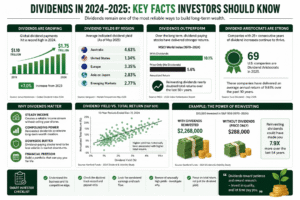
All of the above is not an argument against dividends. It is an argument for understanding them properly.
When done correctly, dividend investing is one of the most effective and psychologically sustainable ways to build wealth. Here is why.
Most investment strategies require you to sell assets to generate income. You buy low, sell high, and collect the difference. This works, but it requires you to constantly monitor prices, time your exits, and deal with the emotional weight of watching your holdings fluctuate.
Dividend investing works differently. You generate income without selling a single share. The cash comes to you. The business keeps working on your behalf. You can hold indefinitely through any market environment and still receive regular payments.
Think about what that means for long-term wealth building. A quality dividend-paying stock held for 20 years delivers:
- Quarterly or semi-annual cash payments throughout those 20 years
- The potential for dividend growth if the company raises its payout over time
- Capital appreciation as the business grows in value
- The ability to reinvest dividends to buy more shares, which accelerates compounding
This combination is why some of history’s most successful long-term investors have built substantial wealth through patient dividend investing in quality businesses.
The Power of Dividend Reinvestment Over Time
Example: $10,000 invested in a stock yielding 4% annually with 6% annual price growth
| Year | Portfolio Value (No Reinvestment) | Portfolio Value (Dividends Reinvested) |
|---|---|---|
| 5 | $13,382 | $15,036 |
| 10 | $17,908 | $22,609 |
| 15 | $23,966 | $33,998 |
| 20 | $32,071 | $51,121 |
| 25 | $42,919 | $76,861 |
| 30 | $57,435 | $115,583 |
The only difference between these two columns is whether dividends were reinvested or taken as cash. Reinvestment roughly doubles the final outcome over 30 years. This is the compounding effect of dividends working inside the compounding effect of price growth at the same time.
What Makes a Dividend Stock Actually Worth Owning
Once you understand the mechanics, the next question is what to actually look for when choosing dividend-paying stocks. The answer comes down to business quality first, yield second.
Characteristics of a Quality Dividend Stock
- Consistent or growing earnings over a multi-year period, not just one good year
- Low to moderate payout ratio that leaves the company financial flexibility
- Manageable debt levels that do not put dividend payments at risk during slow periods
- A track record of maintaining or increasing dividends over time, ideally across at least one economic downturn
- A business with durable competitive advantages that protect its ability to generate cash in the future
- Clear communication from management about dividend policy and future intentions
Some financial databases track companies known as “Dividend Aristocrats” in the USA, which are S&P 500 companies that have increased their dividend for 25 or more consecutive years. The UK has its own equivalent in companies with long unbroken dividend histories on the FTSE 100. Australia’s franking credit system adds an additional layer of tax efficiency to dividends for local investors. These established tracks of consistency are a useful starting filter when researching dividend investments.
Common Dividend Investing Mistakes and How to Avoid Them
| Mistake | Why It Hurts You | What to Do Instead |
|---|---|---|
| Buying a stock purely because the yield is high | High yield often signals a falling price and business problems | Research why the yield is high before buying |
| Ignoring the payout ratio | Unsustainable payouts lead to dividend cuts | Check that earnings comfortably cover the dividend |
| Buying just before the ex-dividend date to collect the payout | You pay full pre-dividend price but the price drops on ex-dividend date | Buy for long-term fundamentals, not short-term payout timing |
| Selling after the ex-dividend price drop | You lock in a paper loss that would recover naturally | Understand that the price drop reflects the cash paid out, not a loss |
| Focusing only on current yield and ignoring dividend growth | A 2% yield that grows 10% annually beats a static 6% yield over 10 years | Look for companies with a history of raising their dividend |
| Concentrating in one high-yield sector | Sector-specific problems can wipe out your income | Diversify across multiple dividend-paying sectors |
A Practical Framework for Evaluating Any Dividend Stock
Before committing money to any dividend-paying company, work through these five questions:
Question 1: Is the business fundamentally healthy?
Look at revenue and earnings trends over the past five years. Are they growing, stable, or declining? A healthy business is the foundation of a sustainable dividend.
Question 2: Can the company actually afford the dividend?
Calculate the payout ratio. Divide the annual dividend per share by the annual earnings per share. Anything above 80% to 85% deserves additional scrutiny.
Question 3: Why is the yield at its current level?
If the yield looks unusually high compared to the company’s history or sector peers, find out why. Has the price fallen recently? If so, what caused it?
Question 4: What is the dividend track record?
Has the company raised, maintained, or cut its dividend over the past 5 to 10 years? A consistent track record, especially through economic downturns, is a positive signal.
Question 5: What is the debt situation?
Companies with high debt loads are more vulnerable to dividend cuts during difficult periods because debt repayments compete directly with dividend payments for the available cash.
Final Thoughts: Dividends Reward Research and Patience
Dividends are not confusing once you understand the mechanics behind them. The ex-dividend price drop is not a warning sign. It is accounting. The price reflects that cash has been distributed.
A high yield is not automatically an attractive opportunity. It may be a red flag that demands investigation before you commit a single dollar.
But when you invest in companies with genuine financial strength, a track record of consistent or growing dividend payments, and a business model built to generate cash over the long term, dividends become exactly what they were designed to be.
A reliable, ongoing reward for owning a good business.
You do not need to sell your shares to generate income. You do not need to perfectly time the market. You simply need to own the right businesses, stay patient through short-term price movements, and let the cash keep arriving in your account quarter after quarter.
That is the real power of dividend investing. And it starts with understanding the trap well enough to avoid it.
Key Takeaways
- When a dividend is paid, the stock price drops by roughly the dividend amount on the ex-dividend date. This is normal, not alarming.
- Your total value before and after a dividend remains the same: the cash paid out simply moves from the company’s balance sheet to your account.
- A high dividend yield is not automatically attractive. If the yield is high because the stock price has fallen, find out why before buying.
- A sustainable payout ratio, consistent earnings, and manageable debt are the most important factors when evaluating dividend stocks.
- Reinvesting dividends over the long term dramatically accelerates compounding and significantly improves total returns.
- The most reliable dividend investments come from businesses with durable competitive advantages and a track record of maintaining or growing their dividend through economic cycles.


